
Some publicity, of the unfavorable kind, has come the way of Panama City Beach, Florida after the national media picked up the story of a gang rape witnessed by scores of people who did absolutely nothing to protect the victim or stop the assaults. This comes on the heels of national media coverage of the shooting of seven people at a Panama City Beach house party a couple of weeks earlier.
Thirteen years ago to the day, I made my own effort to bring these risks to the attention of a national audience, calling out the local authorities for their role in promoting this anything-goes atmosphere that leads to the inevitable harms epitomized by these recent events. I have little sympathy for the boosters: they've created their own monster.
Some things just don't change, even when such tragedies temporarily jump into the national consciousness.
Showing posts with label ETOH. Show all posts
Showing posts with label ETOH. Show all posts
Thursday, April 16, 2015
Wednesday, December 10, 2014
Liquor licenses proliferate
Officer Conan Schafer has recently taken over responsibility for overseeing liquor license investigation and enforcement at the Lincoln Police Department, and liaison with licensees and the City Council on such matters. He has been working on the police department's liquor license database, bringing everything up to date. I asked him to straighten up the addresses a little bit during this process, to try to get them into a consistent format so they will geocode more easily.
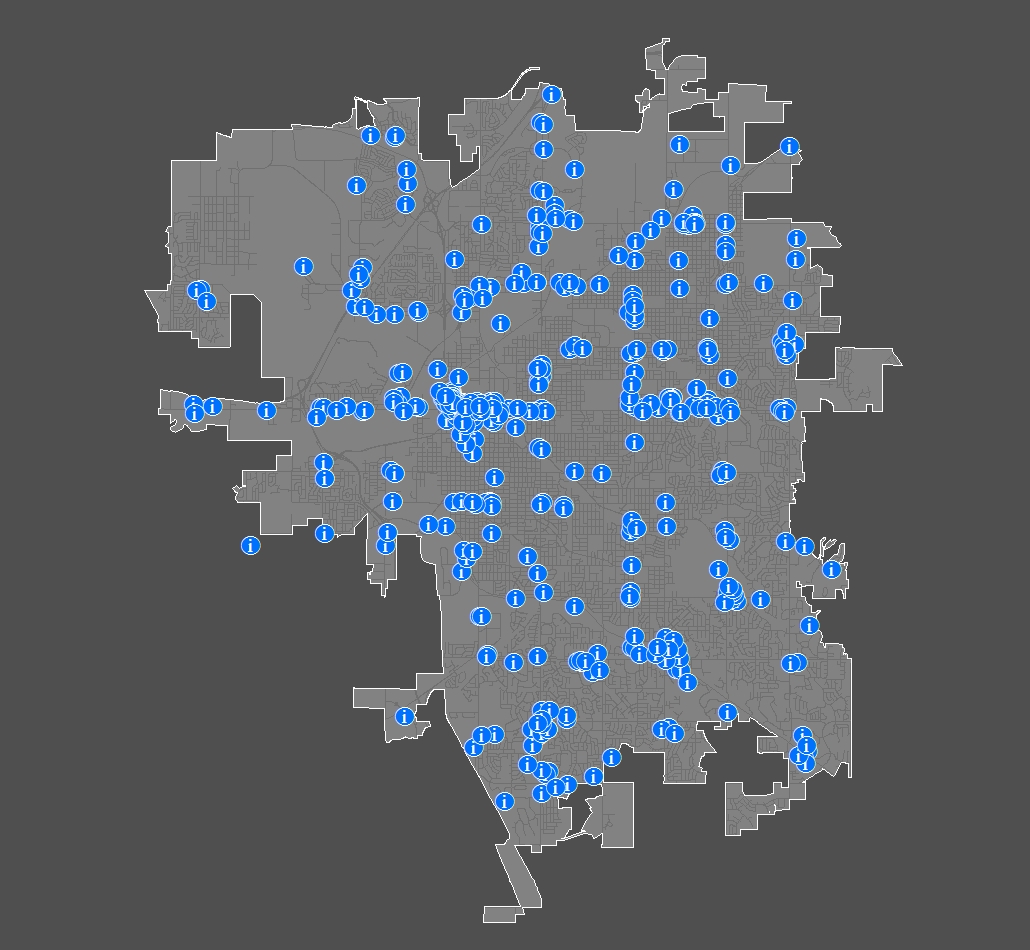
A few times a year, I need a geographic layer of liquor licenses for one reason or another--most recently to provide this information to HunchLab for their predictive algorithm. I usually have to spend some significant time cleaning up the addresses before geocoding, but this time it was a snap. Here's a map of the 481 liquor licenses in Lincoln right now:
I found a slide in a PowerPoint I did for a 2005 conference presentation, which pegged the number of liquor licenses at 373. We appear to have 108 more licenses in 2014 than in 2005, a 29% increase in the past decade. My vague recollection is that the entire City had less than 100 liquor licenses when I pinned on the badge in the summer of 1974.
There's a lot of research about the correlation of alcohol outlets with crime and disorder, particularly associating the density of outlets with these phenomenon. We certainly have some areas in Lincoln with a dense concentration of licenses, but I'm of the opinion that the relationship of alcohol outlets to crime and disorder is quite different based on the type of outlets and their business practices. Don't let the customers get drunk, and problems are considerably reduced, both inside the establishment and in the general neighborhood.
A few times a year, I need a geographic layer of liquor licenses for one reason or another--most recently to provide this information to HunchLab for their predictive algorithm. I usually have to spend some significant time cleaning up the addresses before geocoding, but this time it was a snap. Here's a map of the 481 liquor licenses in Lincoln right now:
 |
| Click image for larger version |
I found a slide in a PowerPoint I did for a 2005 conference presentation, which pegged the number of liquor licenses at 373. We appear to have 108 more licenses in 2014 than in 2005, a 29% increase in the past decade. My vague recollection is that the entire City had less than 100 liquor licenses when I pinned on the badge in the summer of 1974.
There's a lot of research about the correlation of alcohol outlets with crime and disorder, particularly associating the density of outlets with these phenomenon. We certainly have some areas in Lincoln with a dense concentration of licenses, but I'm of the opinion that the relationship of alcohol outlets to crime and disorder is quite different based on the type of outlets and their business practices. Don't let the customers get drunk, and problems are considerably reduced, both inside the establishment and in the general neighborhood.
Wednesday, February 26, 2014
How laws are made
One of the ongoing news items this month has been the application of Marcus Theaters for a liquor license at the Grand, their multi-screen downtown movie house. It seems that some people are just becoming aware of a municipal ordinance (5.04 .120) that prohibits people 15 and under from being in a licensed liquor establishment after 9:00 PM, unless accompanied by someone 21 or older.
I don't think we're exactly awash in junior high kids trolling bars in Lincoln. I can only recall a couple of times in the past quarter century where we've needed to pull this ordinance out of the book in response to a problem. Actually, I may have violated it myself as a 15 year-old in the spring of 1969, in the same circumstances as this affair the following year on January 9, 1970--although I suspect Valentino's did not yet hold a liquor license.
Some people wonder why we have such a law in the first place. I have a theory, which I described a few years ago. Do you think the problems of Mrs. Dennis, Mrs. Shaw and mothers in similar circumstances may have gotten a little worse when a few thousand members of the Army Air Forces came to town in 1942?
Officer Hulda Roper (for whom Roper Elementary School is named) would certainly know. She followed Matron Rickard into the police force in 1944. By then, Chief Joe Carroll had replaced the politically-incorrect job title of Matron with the (now) politically-incorrect job title of Policewoman. One night in late October of 1949, Hulda fired up the audience at the First Evangelical United Brethren Church.

Apparently not only brethren were present. City council member Fern Hubbard Orme introduced an ordinance, and the Lincoln Council of Church Women rallied support.

The Public Safety Director, never far from a reporter's notebook, weighed in on the legal nuance concerning the definition of "taverns".

Thus, thereafter the tots were tossed from taverns at 2100.

And that's how laws are made. In 1949, there were a few dozen "beer taverns" and a handful of private bottle clubs in Lincoln. Liquor by the drink inside the city limits didn't come along until the mid 1960s. No one in 1949 would have envisioned that bowling allies, music halls, arcades, family restaurants, airports, hotels, golf courses, and a laundromat would have liquor licenses--much less a sushi place or a motion picture theater. Nor would they have imagined that two high school sophomores would be violating the law by patronizing a pizza parlor after a high school basketball game.
My first visit to a theater with a liquor license was in Dallas several years ago. It had really nice seats, cocktail tables, some decent small-plates, and a nice selection of beers and wine by the glass--quite similar to the Marcus Midtown in Omaha. It seemed a very low-risk drinking environment. As much as I might long for a return to the days when not every single activity demanded alcohol be served, the fact is that we also need more low-risk drinking environments where the alcohol is a small part of the experience, and not the main attraction--as an alternative to Ms. Rickard's poetic description of the aftermath of a binge 65 years ago, that hasn't changed much since:
I don't think we're exactly awash in junior high kids trolling bars in Lincoln. I can only recall a couple of times in the past quarter century where we've needed to pull this ordinance out of the book in response to a problem. Actually, I may have violated it myself as a 15 year-old in the spring of 1969, in the same circumstances as this affair the following year on January 9, 1970--although I suspect Valentino's did not yet hold a liquor license.
Some people wonder why we have such a law in the first place. I have a theory, which I described a few years ago. Do you think the problems of Mrs. Dennis, Mrs. Shaw and mothers in similar circumstances may have gotten a little worse when a few thousand members of the Army Air Forces came to town in 1942?
Officer Hulda Roper (for whom Roper Elementary School is named) would certainly know. She followed Matron Rickard into the police force in 1944. By then, Chief Joe Carroll had replaced the politically-incorrect job title of Matron with the (now) politically-incorrect job title of Policewoman. One night in late October of 1949, Hulda fired up the audience at the First Evangelical United Brethren Church.
Apparently not only brethren were present. City council member Fern Hubbard Orme introduced an ordinance, and the Lincoln Council of Church Women rallied support.
The Public Safety Director, never far from a reporter's notebook, weighed in on the legal nuance concerning the definition of "taverns".
Thus, thereafter the tots were tossed from taverns at 2100.
And that's how laws are made. In 1949, there were a few dozen "beer taverns" and a handful of private bottle clubs in Lincoln. Liquor by the drink inside the city limits didn't come along until the mid 1960s. No one in 1949 would have envisioned that bowling allies, music halls, arcades, family restaurants, airports, hotels, golf courses, and a laundromat would have liquor licenses--much less a sushi place or a motion picture theater. Nor would they have imagined that two high school sophomores would be violating the law by patronizing a pizza parlor after a high school basketball game.
My first visit to a theater with a liquor license was in Dallas several years ago. It had really nice seats, cocktail tables, some decent small-plates, and a nice selection of beers and wine by the glass--quite similar to the Marcus Midtown in Omaha. It seemed a very low-risk drinking environment. As much as I might long for a return to the days when not every single activity demanded alcohol be served, the fact is that we also need more low-risk drinking environments where the alcohol is a small part of the experience, and not the main attraction--as an alternative to Ms. Rickard's poetic description of the aftermath of a binge 65 years ago, that hasn't changed much since:
"Did succeed in getting her to erp in the toilet. Oh my, I didn't want the lunch I had brought. My lungs are filled with the smell of foulness and liquor. I sure need a cigarette, but am out of them. These night drunks are awful."
Thursday, May 16, 2013
BAC calculator
The National Transportation Safety Board's recommendation this week that states consider dropping the legal limit for driving while intoxicated from a blood alcohol level of .08% to .05% was big news all over the country. I spotted an article in our local press today:
I don't claim to be the world's foremost expert, but I immediately recognized that something important was omitted here. The missing ingredient is time. It takes time to drink, and BAC is basically a math problem between the amount of ethanol, body mass, and time. Basically, your body can't metabolize the alcohol in one standard drink (about a half ounce of pure ethanol) every hour, so if you consume a drink every hour over a period of time, your BAC slowly starts to build up. If you drink faster than one per hour, the concentration of alcohol builds up more quickly. It has nothing to do with tolerance, it's just math.
If the 160 lb. man drank two 12 oz. standard American beers evenly during his first hour of drinking, he would be at about .025% to .035% at the end of that hour--not .05%. It is however, true that the third beer in hour one might put him over .05% at the end of an hour--it would be close. If he drank four in hour one, he'd be getting perilously close to the current legal limit of .08%, as he would with six in three hours. Throttle back to five Buds during a three hour televised football game, though, and he is still comfortably below .08%. Since he has slowed his consumption, his liver is dealing a bit more effectively with his mouth, though still not at equilibrium.
My favorite online blood alcohol calculator is the Drink Wheel, from Intoximeters, Inc.--the company that manufactured the gas chromatographs I was trained to use a long time ago. The flame ionization detector and the Poropak Q column are still on the tip of my 37 degree Celsius tongue, 38 years later. It's called the drink wheel because long before the PC and decades before the Internet, the drink wheel was a circular contraption made of two discs of card stock that you could rotate around to select weight, beverage, and time to produce an estimate. Sure wish I had saved one of those gizmos. We used to hand them out right and left.
It is, however, only an estimate. Govern yourself accordingly, and err on the side of caution.
"That's about one drink for a woman weighing 120 pounds, two for a 160-pound man. A "drink" means 12 ounces of beer, four ounces of wine"
I don't claim to be the world's foremost expert, but I immediately recognized that something important was omitted here. The missing ingredient is time. It takes time to drink, and BAC is basically a math problem between the amount of ethanol, body mass, and time. Basically, your body can't metabolize the alcohol in one standard drink (about a half ounce of pure ethanol) every hour, so if you consume a drink every hour over a period of time, your BAC slowly starts to build up. If you drink faster than one per hour, the concentration of alcohol builds up more quickly. It has nothing to do with tolerance, it's just math.
If the 160 lb. man drank two 12 oz. standard American beers evenly during his first hour of drinking, he would be at about .025% to .035% at the end of that hour--not .05%. It is however, true that the third beer in hour one might put him over .05% at the end of an hour--it would be close. If he drank four in hour one, he'd be getting perilously close to the current legal limit of .08%, as he would with six in three hours. Throttle back to five Buds during a three hour televised football game, though, and he is still comfortably below .08%. Since he has slowed his consumption, his liver is dealing a bit more effectively with his mouth, though still not at equilibrium.
My favorite online blood alcohol calculator is the Drink Wheel, from Intoximeters, Inc.--the company that manufactured the gas chromatographs I was trained to use a long time ago. The flame ionization detector and the Poropak Q column are still on the tip of my 37 degree Celsius tongue, 38 years later. It's called the drink wheel because long before the PC and decades before the Internet, the drink wheel was a circular contraption made of two discs of card stock that you could rotate around to select weight, beverage, and time to produce an estimate. Sure wish I had saved one of those gizmos. We used to hand them out right and left.
It is, however, only an estimate. Govern yourself accordingly, and err on the side of caution.
Tuesday, May 14, 2013
Not entirely unusual
A youtube video of a dust-up at bar break in Lincoln last Saturday night (which was actually 2:23 AM Sunday morning) was getting a bit of attention from the media yesterday. The video shows a couple of small fights, a few women exchanging blows, a couple of people stumbling drunk in the street and sidewalk, and a group of police officers, calmly and professionally trying to disperse the crowd.
As he leaves the area, the videographer warns a couple pedestrians headed the opposite direction to be careful "There's a #@!&+ riot going on over there!" Well, not exactly, but certainly a tense street scene that was expertly handled by the officers, with no one being hurt, and without the police action becoming the flashpoint for an even bigger brouhaha.
Many people who have seen it are somewhat shocked by the scene, but Assistant Chief Brian Jackson and I were remarking how typical it really is. The scuffle may be a little larger than usual, but these kinds of scenes occur from time to time at bar break in similar areas all over the world. I've blogged about this problem on several past occasions. In Lincoln, this occurs at 14th & O Streets, where the bars that cater to the young, hard drinking crowd are congregated. Keeping your cool when surrounded by this kind of behavior is not an easy task. Well done, officers.
As he leaves the area, the videographer warns a couple pedestrians headed the opposite direction to be careful "There's a #@!&+ riot going on over there!" Well, not exactly, but certainly a tense street scene that was expertly handled by the officers, with no one being hurt, and without the police action becoming the flashpoint for an even bigger brouhaha.
Many people who have seen it are somewhat shocked by the scene, but Assistant Chief Brian Jackson and I were remarking how typical it really is. The scuffle may be a little larger than usual, but these kinds of scenes occur from time to time at bar break in similar areas all over the world. I've blogged about this problem on several past occasions. In Lincoln, this occurs at 14th & O Streets, where the bars that cater to the young, hard drinking crowd are congregated. Keeping your cool when surrounded by this kind of behavior is not an easy task. Well done, officers.
Tuesday, December 4, 2012
The environmental approach
In last week's post about Project Extra Mile, I praised Diane Riibe for her advocacy of the environmental approach to underage drinking prevention. Just what is the environmental approach? It is perhaps easiest to explain by contrasting it with an individual approach.
The individual approach focuses on young people who are under the legal drinking age. It uses strategies aimed at convincing them that they should refrain from consuming alcohol until they reach the legal age. It threatens them with consequences for violating the law. It attempts to educate them about the effects of alcohol, and about the risks of underage drinking.
The environmental approach, conversely, focuses on making changes not in the individual, but in the external environment. Such changes often involve public policy and legislation. Typical examples would be raising the legal drinking age, lowering the threshold for driving under the influence, strategies to reduce access to alcohol by those underage, increases in alcohol excise taxes, heightened accountability for adult providers. Tools for an environmental approach might also include compliance checks for retail establishments, efforts to reduce marketing aimed at youth, and more.
I am a strong believer in the environmental approach, and these are strategies that we used extensively during the 12 years I co-chaired Lincoln's campus-community coalition to reduce high risk drinking by young people, NU Directions (which subsequently transitioned to the Nebraska Collegiate Consortium). These strategies, however, do not entirely replace those aimed at individuals. I still firmly believe in holding individual underage drinkers responsible for their actions, and for doing what we can to ensure that they understand the consequences. An environmental approach, however, is appealing in its efficacy: it offers a big bang for the buck.
At last Wednesday's Project Extra Mile recognition dinner, a speaker did a good job of explaining the a dozens of overheated students on the verge of heat-related illness. You could rush about to each, have them stop their physical activity and sit or lie down, apply cool damp washcloths to their head and neck, and provide each with cool water to drink. That would be an individual approach. Or, you could turn down the thermostat, and turn on the ceiling fans--an environmental approach.
Better yet, you could use a combined approach: tweak the HVAC, ramp up the fans, stop the scrimmage, and push the liquids.
The individual approach focuses on young people who are under the legal drinking age. It uses strategies aimed at convincing them that they should refrain from consuming alcohol until they reach the legal age. It threatens them with consequences for violating the law. It attempts to educate them about the effects of alcohol, and about the risks of underage drinking.
The environmental approach, conversely, focuses on making changes not in the individual, but in the external environment. Such changes often involve public policy and legislation. Typical examples would be raising the legal drinking age, lowering the threshold for driving under the influence, strategies to reduce access to alcohol by those underage, increases in alcohol excise taxes, heightened accountability for adult providers. Tools for an environmental approach might also include compliance checks for retail establishments, efforts to reduce marketing aimed at youth, and more.
I am a strong believer in the environmental approach, and these are strategies that we used extensively during the 12 years I co-chaired Lincoln's campus-community coalition to reduce high risk drinking by young people, NU Directions (which subsequently transitioned to the Nebraska Collegiate Consortium). These strategies, however, do not entirely replace those aimed at individuals. I still firmly believe in holding individual underage drinkers responsible for their actions, and for doing what we can to ensure that they understand the consequences. An environmental approach, however, is appealing in its efficacy: it offers a big bang for the buck.
At last Wednesday's Project Extra Mile recognition dinner, a speaker did a good job of explaining the a dozens of overheated students on the verge of heat-related illness. You could rush about to each, have them stop their physical activity and sit or lie down, apply cool damp washcloths to their head and neck, and provide each with cool water to drink. That would be an individual approach. Or, you could turn down the thermostat, and turn on the ceiling fans--an environmental approach.
Better yet, you could use a combined approach: tweak the HVAC, ramp up the fans, stop the scrimmage, and push the liquids.
Thursday, January 5, 2012
Holiday DWI focus
Every year in December, the Lincoln Police Department puts a special focus on drunk driving enforcement. Since the vast majority of drunk driving arrests occur on the late shift, Capt. Marty Fehringer, one of the overnight Duty Commanders, was this year's coordinator, and sent me the results: 213 DWI arrests by LPD during the month of December. This is the all-time single month record for drunk driving arrests in Lincoln. As I have often said, there is nothing that a police officer does that has a greater impact on public safety than arresting a drunk driver. The officers who contributed to this project should be complimented for their efforts.
We weren't alone in focusing on DWI during the month, and the local news has reported on the results from the Lancaster County Sheriff's Office, and the statewide arrests by the Nebraska State Patrol.
Here's an interesting way of looking at LPD's drunk driving arrests: a temporal grid of the past few years, cases. I've blogged before about using this method for visualizing data sets that have strong time-and-day patterns, which is clearly evident in the DWI arrests. You can click on the image to enlarge the view.

This grid, by the way, is a screen capture from our latest version of CrimeView Dashboard. It took me less than five minutes to prepare this for my blog this morning. Performing this analysis and producing a graphic like this a few years ago would have made a decent project for the week. It also would have required a few thousand dollars worth of software on a fat honking PC, and a GIS analyst with extensive training and experience. Now it's a few minutes on my wife's low-end Dell with an iffy WiFi connection in our little home office, while sipping my first cup of joe. Pretty incredible, when you think about it.
We weren't alone in focusing on DWI during the month, and the local news has reported on the results from the Lancaster County Sheriff's Office, and the statewide arrests by the Nebraska State Patrol.
Here's an interesting way of looking at LPD's drunk driving arrests: a temporal grid of the past few years, cases. I've blogged before about using this method for visualizing data sets that have strong time-and-day patterns, which is clearly evident in the DWI arrests. You can click on the image to enlarge the view.

This grid, by the way, is a screen capture from our latest version of CrimeView Dashboard. It took me less than five minutes to prepare this for my blog this morning. Performing this analysis and producing a graphic like this a few years ago would have made a decent project for the week. It also would have required a few thousand dollars worth of software on a fat honking PC, and a GIS analyst with extensive training and experience. Now it's a few minutes on my wife's low-end Dell with an iffy WiFi connection in our little home office, while sipping my first cup of joe. Pretty incredible, when you think about it.
Monday, April 25, 2011
Soaked on Easter
Long time readers of the Chief's Corner know that I often shake my head in wonder at the incidents that occur on holidays. The holiest of the holidays is no exception. On Easter, over a dozen people greeted the sunrise in detox after being tagged in by Lincoln police officers in an intoxicated state in the wee hours of the morning--nine of them for drunk driving. Nine DWI arrests would constitute a pretty productive night under any circumstances at all.
The most bizarre and incongruous alcohol-related call, however, came in later in the day: just shy of 6:00 PM. Officer Justin Feldaus was sent to a cemetary on case number B1-035781, a report that a man in a white shirt and baggy pants was urinating on graves.
Monday, April 18, 2011
Weekend fights
Over the weekend (Friday through Sunday), Lincoln police officers investigated 41 assaults. If that sounds like a lot, it's really not out of the ordinary. Last year, we investigated 4,852, an average of a bit more than 13 per day. Of the 41 assaults, 18 were domestic: they involved people who live together, have lived together, share a child in common, or have a dating relationship. This definition includes roomies, siblings, and even parent and child. Not all domestic assaults fit the expected template. Here is the slightly-sanitized narrative from case number B1-033422, in which a young man called to report a violent attack by his mother:
The 41 assaults occurred at schools, on buses, at residences, on the street, at a community center, a homeless shelter, a nursing home, and a group home. A common thread was alcohol, which was involved in over half the assaults. Here are a couple of lightly-edited excerpts from typical examples of the alcohol-related variety:
Case Number B1-033432
"Mother reports that she and her adult son became involved in an argument over his cursing at her when she told him to fold his clothes from the wash. Son said during this argument his mother struck him on the left shoulder with the wand of the vacuum. He stated this caused him pain. There was no visible injury and Mom denied the accusation."
The 41 assaults occurred at schools, on buses, at residences, on the street, at a community center, a homeless shelter, a nursing home, and a group home. A common thread was alcohol, which was involved in over half the assaults. Here are a couple of lightly-edited excerpts from typical examples of the alcohol-related variety:
Case Number B1-033432
"Victim said he was talking to a girl at a party when the suspect came up to them, was being loud and mouthy and said 'I'll fight you for her.' Victim said suspect then 'sucker punched' him in the side of the head and a fight ensued."Case Number B1-033336
"Victim was contacted walking on the sidewalk with blood running from his mouth. Victim reports that he was walking down the sidewalk on the NE corner of Centennial and O St. A unknown male wearing a black baseball hat, with large biceps and tattoos on his arms struck him in the face causing his top lip to be cut. Victim was unable to give any more description about the party responsible. Victim stated that he didn't want anything done and he only wanted to go home, and walked away from officer with his friends."
Monday, February 21, 2011
Prelude to Spring
Awfully nice weather graced Lincoln on Friday and Saturday. I took advantage of the February thaw to dust of the bike for a nice ride on Saturday morning. I can attest that there is a lot of gravel out there, the motorists aren’t used to seeing humans on two wheels, and every other person in the city must be training for the Lincoln Marathon.
The third shift also had a prelude to spring, with 69 disturbance calls on Saturday, and 26 alcohol-related calls—including 8 drunk drivers. The hour of power—bar break, was particularly busy. The reality of February returned yesterday afternoon. It won’t be long, though, until warming weather exerts its inevitable change on the pace of police work in the City.
Saturday also offered the second screening of an excellent new feature on Nebraska Educational Television. Binge features a few comments by yours truly, and some arresting video of Officer Megan Riffey, Sgt. Jason Goodwin, and Officer Josh Atkinson dealing with the binge drinking scene in Lincoln. There is some particularly good footage of the O Street scene in Lincoln that I believe would be valuable for more Lincoln residents to see and contemplate.
Binge will air again this coming weekend on NET: Thursday, March 3 at 6:00 PM, Friday, March 4 and Saturday, March 5 at 7:30 and 10:30.
The third shift also had a prelude to spring, with 69 disturbance calls on Saturday, and 26 alcohol-related calls—including 8 drunk drivers. The hour of power—bar break, was particularly busy. The reality of February returned yesterday afternoon. It won’t be long, though, until warming weather exerts its inevitable change on the pace of police work in the City.
Saturday also offered the second screening of an excellent new feature on Nebraska Educational Television. Binge features a few comments by yours truly, and some arresting video of Officer Megan Riffey, Sgt. Jason Goodwin, and Officer Josh Atkinson dealing with the binge drinking scene in Lincoln. There is some particularly good footage of the O Street scene in Lincoln that I believe would be valuable for more Lincoln residents to see and contemplate.
Binge will air again this coming weekend on NET: Thursday, March 3 at 6:00 PM, Friday, March 4 and Saturday, March 5 at 7:30 and 10:30.
Monday, January 3, 2011
Fight night
New Years Eve was quite a wild ride. We responded to a total of 40 assaults on December 31st and January 1st. That’s an unusually large number. Of particular note were bar fights.
The first was at the Main Street Café, where a drunken 24 year old patron was being ejected by the staff after being denied service. He allegedly engaged in some fisticuffs with the staff, earning a night in jail.
Next was Red 9, where a fight broke out between two customers. During the fracas, the primary assailant allegedly pulled a knife and stabbed the victim, along with his buddy who tried to break things up. A second interventionist was allegedly slugged and kicked, and a staff member was bit. But it wasn’t over. With two stabbings, a portion of the bar quickly became a crime scene, and the revelers had to be removed. During the attempt to clear the area out, a 66 year old patron, angry that he couldn’t cross through the area to retrieve his coat, allegedly grabbed a police officer’s gun, lost the scuffle, and spent the night in jail charged with assaulting a police officer.
While a bunch of officers were dealing with the investigation of the Red 9 stabbings, another assault occurred at the Fat Toad, where a greeting to a girlfriend by a stranger was not well received by a boyfriend, and a punch in the face followed. Differing accounts of the events led to the officers declining to make any arrests, however.
Still investigating the Red 9 affair, we were dispatched to the Keg, on a report of a fight involving 10-15 people. Sorting who-did-what-to-whom was rather difficult, but one assailant went to jail, and we are looking for a second who had the good sense to leave before we arrived. The last victim walked into police headquarters at 10:40 AM to report that she had been assaulted during the fight at the Keg. She apparently caught a little shut-eye before reporting her victimization.
All of these bar fights occurred within a 45-minute period. Mind you, this is only the bar fights. During the same stretch, we ran on three other assaults at residences, in addition to two traffic crashes, one drunk, a burglary, seven disturbances, a traffic hazard, a telephone offense, a check welfare, and two drunk drivers.
Interestingly, all of the bar fights occurred after 1:00 AM. Last year, the bars would have been closed. Hard to say that they are related to the later closing time, though. It is possible that the same fights would have occurred an hour earlier last year.
The first was at the Main Street Café, where a drunken 24 year old patron was being ejected by the staff after being denied service. He allegedly engaged in some fisticuffs with the staff, earning a night in jail.
Next was Red 9, where a fight broke out between two customers. During the fracas, the primary assailant allegedly pulled a knife and stabbed the victim, along with his buddy who tried to break things up. A second interventionist was allegedly slugged and kicked, and a staff member was bit. But it wasn’t over. With two stabbings, a portion of the bar quickly became a crime scene, and the revelers had to be removed. During the attempt to clear the area out, a 66 year old patron, angry that he couldn’t cross through the area to retrieve his coat, allegedly grabbed a police officer’s gun, lost the scuffle, and spent the night in jail charged with assaulting a police officer.
While a bunch of officers were dealing with the investigation of the Red 9 stabbings, another assault occurred at the Fat Toad, where a greeting to a girlfriend by a stranger was not well received by a boyfriend, and a punch in the face followed. Differing accounts of the events led to the officers declining to make any arrests, however.
Still investigating the Red 9 affair, we were dispatched to the Keg, on a report of a fight involving 10-15 people. Sorting who-did-what-to-whom was rather difficult, but one assailant went to jail, and we are looking for a second who had the good sense to leave before we arrived. The last victim walked into police headquarters at 10:40 AM to report that she had been assaulted during the fight at the Keg. She apparently caught a little shut-eye before reporting her victimization.
All of these bar fights occurred within a 45-minute period. Mind you, this is only the bar fights. During the same stretch, we ran on three other assaults at residences, in addition to two traffic crashes, one drunk, a burglary, seven disturbances, a traffic hazard, a telephone offense, a check welfare, and two drunk drivers.
Interestingly, all of the bar fights occurred after 1:00 AM. Last year, the bars would have been closed. Hard to say that they are related to the later closing time, though. It is possible that the same fights would have occurred an hour earlier last year.
Monday, December 20, 2010
Big night
I mentioned a week ago that we had a pretty big night for DWI arrests on Friday, December 10th, with a total of 10 drunk driving arrests. That’s a pretty productive night, but it can’t hold a candle to the day before yesterday. On Saturday, December 18, LPD officers arrested 17 drunk drivers. That’s the biggest number of arrests on a single day in 2010.
As I have often told our officers, there is nothing a police officer does that has a more immediate impact on public safety than arresting a drunk driver. Great job, night shift officers, on another weekend of life-saving work!
As I have often told our officers, there is nothing a police officer does that has a more immediate impact on public safety than arresting a drunk driver. Great job, night shift officers, on another weekend of life-saving work!
Thursday, December 16, 2010
Time of the crime
I have been promising the news media that I would provide some data eventually on the impact of the change in the mandatory bar closing time in Lincoln from 1:00 AM to 2:00 AM. This change became effective on Sept. 17, and more time will need to pass before we can draw any firm conclusion.
Nonetheless, I took my first stab at analyzing data yesterday, by looking at the time profile of DWI cases before and after the change. The first graph (blue) below presents the time distribution of DWI cases in the (not quite) three months since the change was made, the second (red) shows the distribution during the same period last year, and the third (orange) shows the three months in 2010 immediately prior to the change.

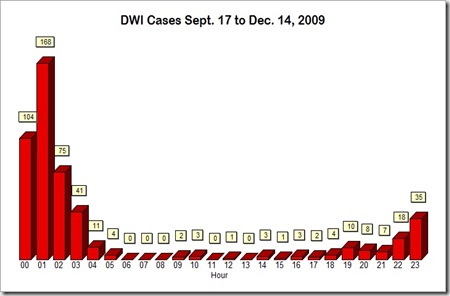
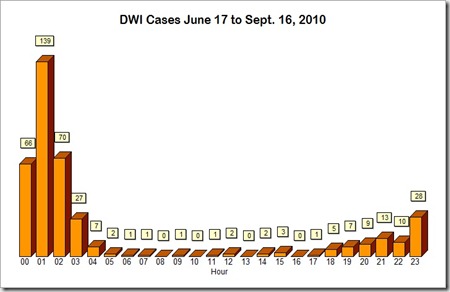
I wouldn’t make much of the difference in the overall numbers, since DWI enforcement is heavily influenced by the available time of officers and by the weather. I do, however, think the time profile is interesting. In comparing the past three months with a 2:00 AM close to both the preceding three months, and to the same period last year, it is evident that the peak has moved to the hour-of-power: now 2:00 AM to 3:00 AM for drunk driving. Moreover, this preliminary look at the data shows that the peak now stretches over a two hour period from 1:00 AM to 3:00 AM. It will be interesting to see if this observation holds as more data is accumulated over time.
Anecdotally, officers tell me that the intensity of bar break seems to be a little less this year with the later closing time. This may mean that the exodus spreads over a longer time period. Mind you, 2:00 AM bar break downtown on weekends is still a sight to behold, but perhaps not quite as crazy as 1:00 AM bar break would have appeared in previous years.
Nonetheless, I took my first stab at analyzing data yesterday, by looking at the time profile of DWI cases before and after the change. The first graph (blue) below presents the time distribution of DWI cases in the (not quite) three months since the change was made, the second (red) shows the distribution during the same period last year, and the third (orange) shows the three months in 2010 immediately prior to the change.


I wouldn’t make much of the difference in the overall numbers, since DWI enforcement is heavily influenced by the available time of officers and by the weather. I do, however, think the time profile is interesting. In comparing the past three months with a 2:00 AM close to both the preceding three months, and to the same period last year, it is evident that the peak has moved to the hour-of-power: now 2:00 AM to 3:00 AM for drunk driving. Moreover, this preliminary look at the data shows that the peak now stretches over a two hour period from 1:00 AM to 3:00 AM. It will be interesting to see if this observation holds as more data is accumulated over time.
Anecdotally, officers tell me that the intensity of bar break seems to be a little less this year with the later closing time. This may mean that the exodus spreads over a longer time period. Mind you, 2:00 AM bar break downtown on weekends is still a sight to behold, but perhaps not quite as crazy as 1:00 AM bar break would have appeared in previous years.
Friday, December 10, 2010
Ten last night
Ten drunk drivers arrested Thursday night/Friday morning. That's a big number for a weekday--or for any day at all, for that matter. December is the month that leads the year, mainly due to the extra focus we give DWI during this season. Be careful out there....
Wednesday, December 8, 2010
He has seniority
Reading reports yesterday morning, I came across a disturbance arrest by Officer Jake Dilsaver. I chuckled over this excerpt from the report, in which the defendant asserts his seniority:
"At detox he was uncooperative with myself and staff, and insulting
toward everyone. The defendant tested .245 BAC, substantiating my concern
for his level of intoxication. The defendant was sure he would be getting
his citation dismissed since he had been a criminal far longer than I had
been a police officer."
Wednesday, November 3, 2010
One of many
By the way, Monday's drunk driver dressed as a breathalyzer wasn't the only DWI arrest over the Halloween weekend. From midnight on Friday to 0500 hours on Monday, there were a total of 26 drunk driving arrests. That's a pretty hefty number for a single weekend. Nor was he the only drunk driver in costume. He was joined at the detox center by a French maid and a naughty border patrol agent.
Thursday, September 9, 2010
Two more emails
These two were received yesterday, on the same topic:
My reply:
Since three separate people this week have contacted me personally, I think we can safely conclude that the alcohol-soaked street scene in some parts of the North Bottoms neighborhood is a problem, and that our efforts to curb it are not totally effective. Sort of like bailing the boat with a teacup, I think, despite excellent effort by the officers on this detail, who netted the equivalent of about two full days of reports, not to mention the future court appearances. If anyone has a practical idea that doesn’t require the two things I don’t have (a boatload of money, and a bunch of police officers), I’m all ears. Keep in mind that I laid off 6 employees last month, lead the smallest police force per capita in Nebraska (and one of the smallest in the region and nation), grew the population equivalent of Auburn, NE last year, and have a huge traffic control issue to attend to on game days which requires about 35 officers and $40,000 of overtime pay--not to mention all the other stuff going on in the City that requires police attention on a game day.
“This past weekend I took my 13 year old daughter and 2 of her friends to the Husker game. We always park in the pubic parking lot South of the Bob Devaney and just West at the train tracks. We then walk 2 blocks west to the pedestrian overpass just North of the stadium to get to the game going through the North Bottoms Neighborhood. The college age kids drinking in this area has become a problem. On the way back to the car after the game my 13 year old daughter was called a "hooker" and 2 of her friends were propositioned for sex. Not exactly behavior any father wants to expose his 13 year daughter to! I am a 10 year season ticket holder and have parked in this location for several years. Over the past few years, the public intoxication and vulgarity has gotten out of hand especially at night games. I hope the Lincoln Police Department is able to start sending officers through the area on foot after the next night game to see for yourself. It is like Mardi Gras! Anyway, I know you are out there, but this North Bottoms neighborhood is getting bad!!! Not something the Huskers nor the city of Lincoln want to be known for, nor is it something Husker fans should have to endure.”
“First off, I would like to say that I appreciate all you and the LPD do for Lincoln. I have been reading your 'blog' for the past couple of months and I enjoy seeing the point of view from the police side. My son has recently moved into some apartments in the north bottoms. We have been there several times in the past month and we went down on Saturday to go to the football game with him. As we were walking to Husker Nation pavilion, we passed by multiple houses with tons of people outside, which my son told me were 'frat tailgates'. There was beer cans all over their lawn, as well as red cups. There was also loud music blaring and a lot of kids coming and going constantly around a makeshift fence of chicken wire and metal rods. We walked past their neighbors and they did not seem too pleased. I was wondering what your personnel do on days before Husker football games to control these types of parties, and I was also wondering why they have a makeshift fence up. Is it there as a barrier? These are just questions from a mother concerned for her son and for her son's safety. Thank you for your time,”
My reply:
“I was in the North Bottoms personally during the pre-game period, and the problems were, as always, predictable. I was in plain clothes with my 26 year old daughter just to survey the scene—we were not going to the game. I can attest to the somewhat more sober version of what you encountered post-game.
This year, we had a special project underway to try to minimize this kind of behavior in the North Bottoms, utilizing three officers on foot. The officers issued scores of tickets for consuming alcohol on public property, minor in possession, urinating in public and similar offenses. I think the problem is twofold: people are ruder than ever, and we are simply not able to commit enough resources to effectively combat the widespread vulgarity you encountered—especially when 85,000 people expect us to get them through traffic in the post-game crush.
I don’t know what to do about the incredible lack of civility that seems to attend our culture these days. Forty criminal citations in a short time within a small area is a lot, but it is a drop in the bucket compared to the number of people who were acting caddishly. Don’t think for a moment, though, that we intend to ignore it. We will do what we can with the resources that we have available.”
Since three separate people this week have contacted me personally, I think we can safely conclude that the alcohol-soaked street scene in some parts of the North Bottoms neighborhood is a problem, and that our efforts to curb it are not totally effective. Sort of like bailing the boat with a teacup, I think, despite excellent effort by the officers on this detail, who netted the equivalent of about two full days of reports, not to mention the future court appearances. If anyone has a practical idea that doesn’t require the two things I don’t have (a boatload of money, and a bunch of police officers), I’m all ears. Keep in mind that I laid off 6 employees last month, lead the smallest police force per capita in Nebraska (and one of the smallest in the region and nation), grew the population equivalent of Auburn, NE last year, and have a huge traffic control issue to attend to on game days which requires about 35 officers and $40,000 of overtime pay--not to mention all the other stuff going on in the City that requires police attention on a game day.
Tuesday, September 7, 2010
Hectic weekend
Nebraska’s first home game always makes for a hectic weekend, and despite the absence of the State Fair from Labor Day weekend for the first time in a century, the police activity did not disappoint. On Friday, we responded to 447 incidents, on Saturday it was 482, and on Sunday 411. Our average daily total this year has been 354. Notably, there were 68 assaults over those three days while our average daily number of assaults this year has been 13. Most of those weekend assaults, no doubt, were alcohol related.
Here’s my favorite weekend phone message for the Chief forwarded from the Police Service Desk. :
XXXXX WANTED TO CALL AND COMPLAIN ABOUT THE ALCOHOL ABUSE AND ALL THE BEER CANS THAT WERE LEFT ON THE WALKOVER BRIDGE AROUND 11/Y ON 09/04/2010. SHE CAN BE REACHED AT HOME 402 XXXXXXX OR HER CELL PHONE 402XXXXXXX.
No kidding.
On the subject, we will now get a chance to see how the adoption of a 2:00 AM closing time for bars impacts police incidents. The closing time change enacted by the City Council becomes effective on September 17. Just as a short and informal test, we could compare the last two weeks of 1:00 AM with the first two weeks of 2:00 AM—if someone reminds me to do so.
Here’s my favorite weekend phone message for the Chief forwarded from the Police Service Desk. :
XXXXX WANTED TO CALL AND COMPLAIN ABOUT THE ALCOHOL ABUSE AND ALL THE BEER CANS THAT WERE LEFT ON THE WALKOVER BRIDGE AROUND 11/Y ON 09/04/2010. SHE CAN BE REACHED AT HOME 402 XXXXXXX OR HER CELL PHONE 402XXXXXXX.
No kidding.
On the subject, we will now get a chance to see how the adoption of a 2:00 AM closing time for bars impacts police incidents. The closing time change enacted by the City Council becomes effective on September 17. Just as a short and informal test, we could compare the last two weeks of 1:00 AM with the first two weeks of 2:00 AM—if someone reminds me to do so.
Wednesday, August 25, 2010
Alcohol-fueled assaults
Last weekend was one of our busy ones—the final blast before the fall semester starts. Our late shift officers certainly kept busy, but the cauldron never quite boiled over. We did, however, have a rather violent weekend, with 55 assaults on Friday, Saturday, and Sunday. None life-threatening, but several requiring medical treatment.
Of the 55 assaults, officers recorded “alcohol involved” on 31 of the Incident Reports. A third were within a par five of the intersection of 14th and O Streets, where the twenty-something bars cluster. Here is the timeline on when the 31 alcohol related assaults occurred (no surprise):

Of the 55 assaults, officers recorded “alcohol involved” on 31 of the Incident Reports. A third were within a par five of the intersection of 14th and O Streets, where the twenty-something bars cluster. Here is the timeline on when the 31 alcohol related assaults occurred (no surprise):

Monday, August 23, 2010
Fatherly advice
Would it surprise you to learn that a few tickets for minor in possession of alcohol were issued over the course of the last weekend before the start of classes at our colleges and universities? Friday, I received an email from the father of a 19 year old UNL sophomore who got one of those tickets, in the wee hours that same day. His son was a victim of circumstances. He had been called by his friends, who needed a sober driver to come pick them up at a party and take them home. It was the friends who had the beer. His son hadn’t even been drinking. He was an innocent bystander trying to be a good Samaritan. What’s more, something quite similar happened to him when he received another MIP citation a couple of years ago in his own home town. The local police wouldn’t listen to him then, either.
Right.
Here’s my response:
I realize this is a little long winded, but it still might be good for all parents of teens and young adults to read this and save it for future reference, particularly if you are about to tell the chief of police that your son or daughter did nothing wrong, and would never lie to his parents. Add it to my other parental advice.
Right.
Here’s my response:
“After your email was routed to me, I read the reports. Your son's account is wildly different than the events reflected in the officers' reports. The difference is far greater than could be explained by a different angle, viewpoint, or perception. Ultimately, when the facts are in dispute, these cases are decided in court, but the version your son provided is so vastly different, I think something else may be going on here. I'm a father, too, and I hope you will allow me to give you my advice as a father. I think you have two choices: forget about the discrepancy, accept the fact that your son might be trying to save face with his dad, and help him deal with the consequences. Alternatively, you could ask him again. If you chose to do that, first let him know that you have spoken to the chief of police. He might--and I stress might--be a little more forthcoming. Sometimes, however, when you've told a tall tale, you are so committed to it that instead of acknowledging that it might not have happened quite the way you said, you continue to embellish the whopper and dig yourself into an even deeper ethical hole.
I would be happy to sit down with you and discuss the details, but he's an adult, and your son probably ought to be the one who decides whether he wants that to happen or not. You know him well, but I would just ask you to remember that we all tend to tell things in a way that makes us appear a little less culpable when we have done something regrettable. Personally, I'd give him the space to do so, rather than insist on getting the bottom of the story. But if you and he want to do so, we can hash this out. I can't think of any reason at all it would be beneficial in any way for the officer to recount a completely inaccurate version of the events. If she did so, it would not be at the risk of her Dad being disappointed, rather it would be at the risk of her job as a Lincoln police officer, and her career in law enforcement. I think it is far more likely that your son is painting a picture of the events calculated to explain how he received the ticket without admitting to some conduct he knows would be terribly disappointing to his parents. Even good people do dumb things.
Think back to your own youth, and recall some occasion when you failed live up to your parents expectations. Did you ever stretch things, deflect some of the blame elsewhere, omit a few pertinent details, or anything of the sort?
Regards,
Tom Casady, Chief of Police”
I realize this is a little long winded, but it still might be good for all parents of teens and young adults to read this and save it for future reference, particularly if you are about to tell the chief of police that your son or daughter did nothing wrong, and would never lie to his parents. Add it to my other parental advice.
Subscribe to:
Posts (Atom)
