Monday, June 18, 2012

Way out east

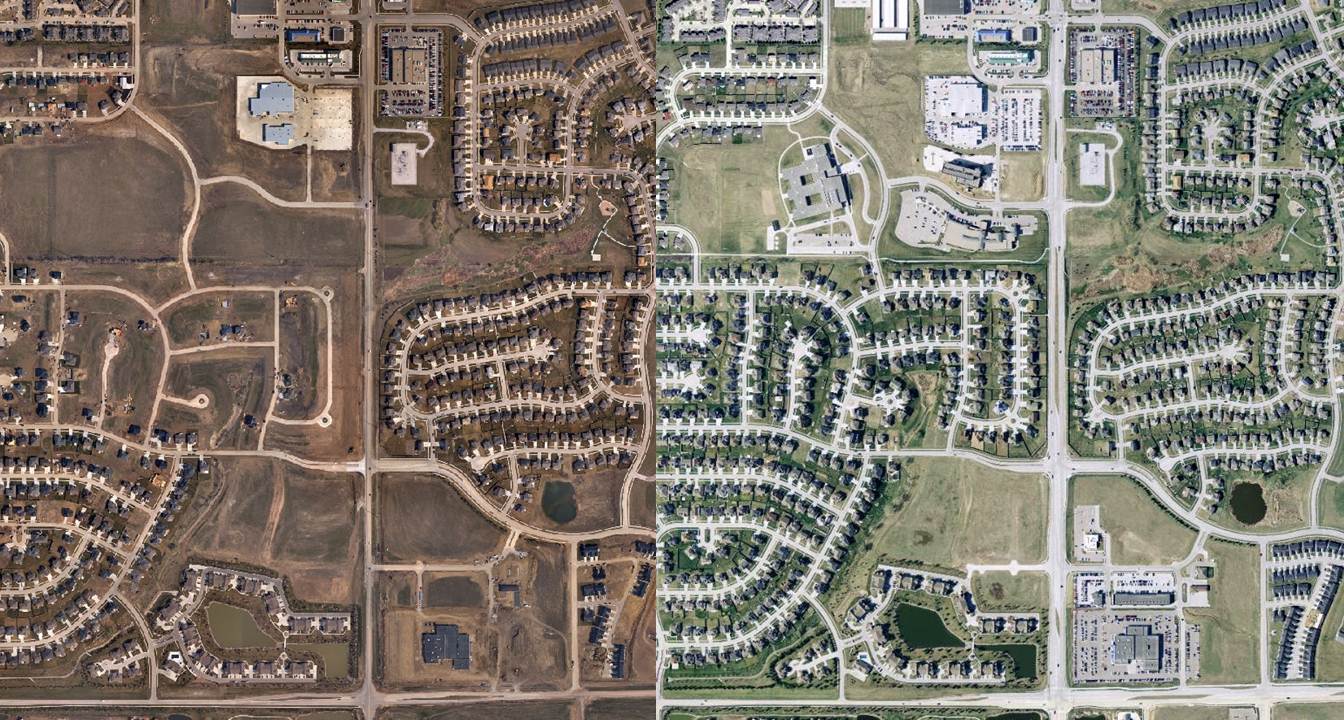
I noticed that the City of Lincoln is preparing to annex Sky Ranch Acres, essentially moving the City limits out to 112th and Holdrege. There has been some incredible eastward growth in recent years. Here's a snapshot of the area along N. 84th St. between Leighton Ave. and Holdrege Street. The sepia-toned image on the left was shot in 2005, the image on the right in the Spring of 2010:

Click image for larger view
Across town, here's another comparison between 2005 and 2010, in the vicinity of S. 27th and Grainger Parkway (that's Yankee Hill Road along the bottom edge):


There has been even more change in both of these areas since the 2010 photos.  Lincoln continues to grow at a rate of about 1.4% annually.  That may not sound like much, but on a base of 258,000 it means we are adding about 3,600 residents to Lincoln every year--about the population of Gothenburg or O'Neill, Nebraska.

Friday, June 15, 2012

Perplexed by sign

I was in Washington, DC yesterday. Earlier this year, I was appointed to the National Institute of Justice's Scientific Review Panel, and we had our first meeting Wednesday and Thursday. I was on my way to the Metro to catch a train to the airport when I spotted this sign and couldn't resist the photo opportunity. Can someone please explain this to me?

Thursday, June 14, 2012

Interesting article

There is a nice article in the May edition of Law Officer concerning information resources and technology at the Lincoln Police Department. The article mentions several topics that have been covered here in my blog over the past few years.

Tuesday, June 12, 2012

Grab the right curb

Yesterday on my way home, I caught a glimpse in my rear view mirror of Battalion 1 southbound on S. 9th Street, heading for a working fire in southwest Lincoln.  I saw the chief approaching from about a half mile away, and when Bat 1 was about four blocks behind me, I grabbed a piece of the right curb.  Most of the other motorists on 9th Street did the same, but several continued on their merry way, and I counted three who pulled over the the left curb.

I've never understood what's so difficult to understand about pulling to the right and stopping upon the approach of an emergency vehicle, but after watching this phenomenon since the Nixon administration, I can't say that it's gotten any better over time.  In the interest of full disclosure, it was only the last couple of weeks of the Nixon administration.  

On a related but unrelated note, I actually saw someone at 56th and Van Dorn over the weekend making a hand signal for a right turn.  He must have blown a fuse. I was pretty impressed that the driver of that pickup knew how to signal a right turn, and also pretty glad he did--I was right behind him, and there were no brake lights, either.  Extra credit if you recall the hand signal for slowing or stopping.

Friday, June 8, 2012

Loud and proud

I had my ear bent this week by a longtime Lincoln businessman who called about motorcycles. He's increasingly annoyed by loud bikes with low-impedance exhaust systems, or even open pipes, and wanted to know why the police don't do something about this. Fact of the matter is that we do, and the offense of unnecesary noise, covered in two chapters of the municipal code, is a fairly common ticket.

It is not, however, common enough to stick a sock in every tailpipe. The caller observed that the problem has increased in recent years, and I tend to agree. Motorcycle registrations are up in Nebraska, and it seems to me that every dentist has acquired a Harley. Not to pick on dentists, though, as I watch cops, judges, lawyers, and accountants roll into work daily on their steeds. Sometimes I think I'm the only upper-middle income 58 year old in Lincoln without a motorcycle.

The loud pipes seem to be a source of pride to many motorcyclists, for reasons beyond my comprehension. Adding to the din are the cafe racers, whose pitch is higher, but equally annoying when you're trying to enjoy a little peace on your patio. In the end, all I could do was commiserate with the complainant. An occasional ticket is not entirely effective in combatting a cultural phenomenon.

Wednesday, June 6, 2012

New view

The recent replacement of the 911 telephone system in Lincoln's Emergency Communications Center also included an update to the mapping software.  Since the old system was nearly 10 years old, you can probably imagine that the new version comes with some enhanced capabilities.  Among these are the integration of Pictometry.  The final work on this integration was taking place yesterday.

An incoming 911 call is automatically plotted on the map, and the call taker or dispatcher can quickly launch the oblique image for that vicinity.  These images are similar to those used in Bing Maps' "Bird's Eye View."  I think that in certain circumstances, the ability to visualize the area of the incident may be quite helpful for dispatchers, who are in a windowless room in the bowels of the Hall of Justice.  Here's another sample image from Lincoln's Pictometry data, compared to the standard overhead aerial orthophoto.  Both of these are excellent high resolution images, but the oblique view has some advantages:


Monday, June 4, 2012

Travel time

The final element in this response time series is travel time.  Simply put, travel time begins when the wheels on an ambulance or fire apparatus start turning, and ends when they stop. Travel time is influenced by several different things: roadway capacity, traffic, weather, and navigation  accuracy--to name a few.  In the public safety business, travel time can generally be estimated by examining distance and the posted speed limit.

Experiments have shown that emergency responders are actually doing quite well if the travel time divided by distance averages the speed limit.  This is exactly how we conducted the analysis for Lincoln Fire & Rescue's fire station optimization plan.  Using GIS software, we just calculated the extent of the area that could be reached from each of Lincoln's 14 fire stations within four minutes if averaging the posted speed limit on the roadway network.  Fast driving does not help: smooth and safe wins the race, coupled with good navigation.  Remember when some Type A driver passed you, only to be stuck at the next light as you glided by in the adjacent lane?

Total response time, thus, is the sum of call processing time, turnout time, and travel time.  Of the three, travel time is the longest interval, and thus of particular interest when your goal is to maintain a reasonable response time to life-threatening emergencies.

Friday, June 1, 2012

Turnout time

Monday's post about the elements that comprise response time began with a discussion of call processing time.  Today's topic is turnout time: the interval from the time the assigned units are notified of the emergency until the wheels start moving.  There are a few different ways that emergency responders can be notified of a dispatch: a voice announcement over the radio, an audible alarm at a station, or an electronic message delivered to a device like a computer, phone or pager.  Most emergency response systems use a combination.  In Lincoln, we use all three.

When an fire company or an ambulance crew is assigned to a emergent call, a tone sounds on a PA system in the station, a voice dispatch to the unit is made over our radio system, and an electronic message is delivered to the mobile data computer in the vehicle.  Once the alarm has been received, the assigned units have some work to do: drop whatever they had been doing previously, proceed to the apparatus, don any protective equipment, enter the vehicle, strap in, start the unit, open the door, and roll.  Once again, all of the steps take a little bit of time, and there are many variables in play.  If you're all standing near the engine at 3:00 PM, and the dispatch is to a medical emergency that would not require bunker gear, you are rolling pretty quickly.  If it's 3:00 AM and the dispatch is to a overturned tanker car, it will likely take considerably longer to get under way.

For Lincoln Fire & Rescue, we would like our turnout time for medical emergencies to be 60 seconds or less, 90% of the time.  For response to fire, rescue, and hazmat incidents, our goal is 80 seconds or less, 90% of the time. These goals are not pulled from the air, rather they are best-practices benchmarks established by the leading authority on fire safety, the National Fire Prevention Association (NFPA), a non-profit that has been developing and publishing standards concerning fire safety for over a century.