
Wednesday, November 3, 2010
One of many
By the way, Monday's drunk driver dressed as a breathalyzer wasn't the only DWI arrest over the Halloween weekend. From midnight on Friday to 0500 hours on Monday, there were a total of 26 drunk driving arrests. That's a pretty hefty number for a single weekend. Nor was he the only drunk driver in costume. He was joined at the detox center by a French maid and a naughty border patrol agent.
Monday, November 1, 2010
I'm predicting this
In the past year, I have blogged a few times about the concept of predictive policing: using data and information to get out in front of crime and disorder--hopefully with a prevention or early intervention strategy. It is a way of thinking that comes pretty naturally to Lincoln police employees, who have been immersed in information and involved in proactive policing for a good long while.
Early last week, I was representing the International Association of Crime Analysts (IACA) by helping to staff their exhibit at the huge annual police chiefs' chiefs conference. Although I wasn't planning on making any presentations at the conference, I was pressed into service at the last minute by a colleague from Arlington, Texas: Jim Mallard. Jim supervises the Crime Analysis Unit at the Arlington PD, and he was scheduled for one of the principal presentations at the conference, along with Chief T. Bowman. Chief Bowman had been delayed in Arlington in the aftermath of the Texas Ranger's league championship. How would you like to have the Super Bowl and the World Series in your City during the same year?
I was happy to fill in. Fortunately I have been writing about predictive policing lately, so I had some thoughts in mind, and all went well. You can read a little bit about the session Jim and I presented here. The session was interpreted live in several languages, and I'm hoping that some of the colloquialisms I used mad sense in Spanish, French, and Portuguese. I got a good laugh recently when I used the phrase "madder than a wet hen", which I incorrectly thought was a pretty universal expression.
Back to Chief Bowman: I encountered him several weeks ago working email, reading documents, surfing the web, checking the news, and keeping in touch with the office via an Apple iPad tethered to a Sprint Overdrive. He's the first chief I've seen managing his communications with an iPad, just like me. I'm predicting this in policing: the tablet computer is going to overtake current police mobile data computers rather quickly. It is a natural for police officers, and makes more sense than the hardened docked laptops that presently rule the transmission hump. Give me a vehicle docking solution for the iPad and a grab-and-go case with a hand strap, and the tablet makes perfect sense for police officers who are in and out of vehicles and buildings all day long. It won't be too long before the vendors of police mobile data applications figure this out and design their products for this form factor.
Early last week, I was representing the International Association of Crime Analysts (IACA) by helping to staff their exhibit at the huge annual police chiefs' chiefs conference. Although I wasn't planning on making any presentations at the conference, I was pressed into service at the last minute by a colleague from Arlington, Texas: Jim Mallard. Jim supervises the Crime Analysis Unit at the Arlington PD, and he was scheduled for one of the principal presentations at the conference, along with Chief T. Bowman. Chief Bowman had been delayed in Arlington in the aftermath of the Texas Ranger's league championship. How would you like to have the Super Bowl and the World Series in your City during the same year?
I was happy to fill in. Fortunately I have been writing about predictive policing lately, so I had some thoughts in mind, and all went well. You can read a little bit about the session Jim and I presented here. The session was interpreted live in several languages, and I'm hoping that some of the colloquialisms I used mad sense in Spanish, French, and Portuguese. I got a good laugh recently when I used the phrase "madder than a wet hen", which I incorrectly thought was a pretty universal expression.
Back to Chief Bowman: I encountered him several weeks ago working email, reading documents, surfing the web, checking the news, and keeping in touch with the office via an Apple iPad tethered to a Sprint Overdrive. He's the first chief I've seen managing his communications with an iPad, just like me. I'm predicting this in policing: the tablet computer is going to overtake current police mobile data computers rather quickly. It is a natural for police officers, and makes more sense than the hardened docked laptops that presently rule the transmission hump. Give me a vehicle docking solution for the iPad and a grab-and-go case with a hand strap, and the tablet makes perfect sense for police officers who are in and out of vehicles and buildings all day long. It won't be too long before the vendors of police mobile data applications figure this out and design their products for this form factor.
Friday, October 29, 2010
Protect your pumpkin
No, this isn't a warning about the controversy du jour regarding helmet-to-helmet hits in college and professional football. Rather, it is my annual warning about the upswing in gourd-related offenses. It's already started, and the mailboxes, rear view mirrors and car windows are my chief concern. If you leave the ammo out on your front stoop, you shouldn't be entirely surprised when the vandals take advantage of it. But the $50 destruction of your mailbox by a pumpkin tossed from a passing car, or a couple hundred for your rear windshield is another matter. That's a significant crime.
The chances of catching a pumpkin flinging Grand Am are slim. The chances that the juvenile offenders will suffer an appropriate consequence and that the victims will be made whole is even slimmer. Thus, prevention is the key. The formula is pretty simple. Protect your pumpkins. Not so much from theft, but from use to destroy your neighbor's property. Pull them inside off the steps for the next few nights as you are double checking your garage door. While your at it, move your daughter's car from the street into the driveway. Yes, I know you'll have to move it again so you can get out to go to work in the morning, but please indulge me for just a few days. You'll be glad you did.
The chances of catching a pumpkin flinging Grand Am are slim. The chances that the juvenile offenders will suffer an appropriate consequence and that the victims will be made whole is even slimmer. Thus, prevention is the key. The formula is pretty simple. Protect your pumpkins. Not so much from theft, but from use to destroy your neighbor's property. Pull them inside off the steps for the next few nights as you are double checking your garage door. While your at it, move your daughter's car from the street into the driveway. Yes, I know you'll have to move it again so you can get out to go to work in the morning, but please indulge me for just a few days. You'll be glad you did.
Thursday, October 28, 2010
Many other crimes
Choosing Lincoln's ten most infamous crimes was a challenge. Although the top two were easy, the picture quickly became clouded. We tend, of course, to forget our history rather quickly. Many of the crimes I felt were among the most significant are barely remembered today, if not completely forgotten.
Some readers will take issue with my list. Several comments have mentioned other crimes that were certainly major events in the City. In choosing ten, here are the others I considered, in no particular order. They are all murders:
Mary O'Shea
Nancy Parker
Charles Mulholland
Victoria Lamm and Janet Mesner
Martina McMenamin
Regina Bos (presumably murdered)
Patty Webb
Marianne Mitzner
I also thought about the five murder-suicides in which a mother or father killed multiple family members before taking their own life. Though tragic, these crimes did not command the same kind of attention as the others, perhaps because there was no lengthy investigation, no tantalizing whodunit, no stranger-killer, nor any of the details that come out in the coverage of a major trial.
The Sereies:
Some readers will take issue with my list. Several comments have mentioned other crimes that were certainly major events in the City. In choosing ten, here are the others I considered, in no particular order. They are all murders:
Mary O'Shea
Nancy Parker
Charles Mulholland
Victoria Lamm and Janet Mesner
Martina McMenamin
Regina Bos (presumably murdered)
Patty Webb
Marianne Mitzner
I also thought about the five murder-suicides in which a mother or father killed multiple family members before taking their own life. Though tragic, these crimes did not command the same kind of attention as the others, perhaps because there was no lengthy investigation, no tantalizing whodunit, no stranger-killer, nor any of the details that come out in the coverage of a major trial.
The Sereies:
Tuesday, October 26, 2010
Number 1: Starkweather
The subject of several thinly-disguised movie plots and a Springsteen album, the Starkweather murders are clearly the most infamous crime in Lincoln’s history—so far. One of the first mass murderers of the mass media age, six of Starkweather’s 11 victims were killed inside the City of Lincoln, and the first was just on the outskirts of town. I didn’t live in Lincoln at the time, but my wife was a first grader at Riley Elementary School, and has vivid memories of the City gripped by fear in the days between the discovery of the Bartlett murders and Starkweather’s capture in Wyoming.
The case caused quite an uproar. There was intense criticism of the police department and sheriff’s office for not capturing Starkweather earlier in the week after the discovery of the Bartlett’s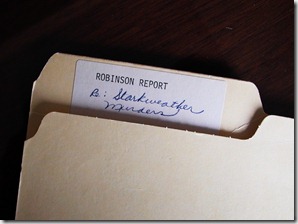 bodies. Ultimately, Mayor Bennett Martin, and the County Board of Commissioners retained a retired FBI agent, Harold G. Robinson, to investigate the performance of local law enforcement. His report essentially exonerated the local law officers, and made a few vanilla recommendations for improving inter-agency communication and training. A faded copy resides in my desk drawer, passed down through five chiefs.
Now I know that many readers are mumbling to themselves “how obvious.” Hold your horses, though. It’s not quite as obvious as you might think. I recently had two experiences that drove this fact home to me. The first was a visit by a small group of journalism students. Only one member of the class had any idea, and her idea was pretty vague. You need to remember that the Starkweather murders were in 1957 and 1958—before the parents of many college students were even born.
The second experience was a visit by a Cub Scout den. I was giving the kids a tour of the police station one evening. We were in the front lobby waiting for everyone to arrive. As I entertained the boys, I told the moms and dads that they might enjoy a small display in the corner of the Sheriff’s Office display case: the contents of Starkweather’s wallet—discovered a couple years ago locked up in the Lancaster County Sheriff’s Office safe. After a few minutes, one of the confused fathers asked me who Starkweather was, and why it was significant.

The Sereies:
The case caused quite an uproar. There was intense criticism of the police department and sheriff’s office for not capturing Starkweather earlier in the week after the discovery of the Bartlett’s
 bodies. Ultimately, Mayor Bennett Martin, and the County Board of Commissioners retained a retired FBI agent, Harold G. Robinson, to investigate the performance of local law enforcement. His report essentially exonerated the local law officers, and made a few vanilla recommendations for improving inter-agency communication and training. A faded copy resides in my desk drawer, passed down through five chiefs.
 Now I know that many readers are mumbling to themselves “how obvious.” Hold your horses, though. It’s not quite as obvious as you might think. I recently had two experiences that drove this fact home to me. The first was a visit by a small group of journalism students. Only one member of the class had any idea, and her idea was pretty vague. You need to remember that the Starkweather murders were in 1957 and 1958—before the parents of many college students were even born.
The second experience was a visit by a Cub Scout den. I was giving the kids a tour of the police station one evening. We were in the front lobby waiting for everyone to arrive. As I entertained the boys, I told the moms and dads that they might enjoy a small display in the corner of the Sheriff’s Office display case: the contents of Starkweather’s wallet—discovered a couple years ago locked up in the Lancaster County Sheriff’s Office safe. After a few minutes, one of the confused fathers asked me who Starkweather was, and why it was significant.

The Sereies:
Monday, October 25, 2010
Number 2: Lincoln National Bank
On the morning of September 17, 1930 a dark blue Buick carrying six men pulled up in front of the Lincoln National Bank at the northwest corner of 12th and O Street. Five of the men entered the bank while a sixth stood outside by the Buick, cradling a machine gun. Observing the unusual events, a passerby called the police. The officer who responded, Forrest Shappaugh, was casually instructed by the machine gun toting lookout to just keep going, which he wisely did. Returning with reinforcements, the robbers had already made good on their getaway, netting $2.7 million in cash and negotiable securities.
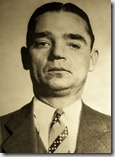 Ultimately, three of the six suspects were arrested. Tommy O’Connor and Howard Lee were convicted and sentenced. Jack Britt was tried twice but not convicted by a hung jury. Gus Winkeler, a member of Al Capone’s gang, winged a deal with County Attorney Max Towle to avoid prosecution in exchange for orchestrating the recovery of $600,000 in bearer bonds. The following year, Winkeler was murdered in Chicago, the victim of a gangland slaying. The final two robbers were never identified.
The Lincoln National Bank robbery stood as the largest cash bank robbery in the United States for many decades. It precipitated major changes at the Lincoln Police Department. Chief Peter Johnstone was rapidly “retired” after the robbery, the department’s fleet was upgraded to add the first official patrol cars, the full force was armed, and a shotgun squad was organized. Forty four years later when I was hired at LPD, the echo of the Lincoln National Bank robbery was still evident in daily bank opening details, and in the Thomspon submachine guns and Reising rifles that detectives grabbed whenever the robbery alarm sounded at headquarters.
The Sereies:
Ultimately, three of the six suspects were arrested. Tommy O’Connor and Howard Lee were convicted and sentenced. Jack Britt was tried twice but not convicted by a hung jury. Gus Winkeler, a member of Al Capone’s gang, winged a deal with County Attorney Max Towle to avoid prosecution in exchange for orchestrating the recovery of $600,000 in bearer bonds. The following year, Winkeler was murdered in Chicago, the victim of a gangland slaying. The final two robbers were never identified.The Lincoln National Bank robbery stood as the largest cash bank robbery in the United States for many decades. It precipitated major changes at the Lincoln Police Department. Chief Peter Johnstone was rapidly “retired” after the robbery, the department’s fleet was upgraded to add the first official patrol cars, the full force was armed, and a shotgun squad was organized. Forty four years later when I was hired at LPD, the echo of the Lincoln National Bank robbery was still evident in daily bank opening details, and in the Thomspon submachine guns and Reising rifles that detectives grabbed whenever the robbery alarm sounded at headquarters.
The Sereies:
Thursday, October 21, 2010
Number 3: The Last Posse
My first inkling about this crime came about 20 years ago, when I was the chief deputy sheriff. One of my interns, a young man named Ron Boden (now a veteran deputy sheriff), had been doing some research on Lancaster County’s only known lynching, in 1884. I came across a reference in the biography of the sheriff at the time, Sam Melick, to the murder of the Nebraska Penitentiary warden, and subsequent prison break. Melick had been appointed interim warden after the murder, and instituted several reforms.
Several years later, a colleague, Sgt. Geoff Marti, loaned me a great book, Gale Christianson’s Last Posse, that told the story of the 1912 prison break in gory, haunting, and glorious detail.

To make a long story short, convict Shorty Gray and his co-conspirators shot and killed Warden James Delahunty, a deputy warden, and a guard on Wednesday, March 13, 1912. They then made their break—right into the teeth of a brutal Nebraska spring blizzard. Over the course to the next few days, a posse pursued. During the pursuit, the escapees carjacked a young farmer with his team and wagon. As the posse closed in, a gunfight broke out and the hostage was shot and killed in the exchange, along with two of the three escapees.
There was plenty of anger among the locals in the Gretna-Springfield vicinity about the death of their native son, and a controversy raged over the law enforcement tactics that brought about his demise. Lancaster County Sheriff Gus Hyers was not unsullied by the inquiry, although it appears from my prospect a century later that the fog of war led to the tragedy. Hindsight was still 20-20 a century ago.
Christianson, a professor of history at Indiana State University who died earlier this year, notes the following on the flyleaf:
The Sereies:
Several years later, a colleague, Sgt. Geoff Marti, loaned me a great book, Gale Christianson’s Last Posse, that told the story of the 1912 prison break in gory, haunting, and glorious detail.

To make a long story short, convict Shorty Gray and his co-conspirators shot and killed Warden James Delahunty, a deputy warden, and a guard on Wednesday, March 13, 1912. They then made their break—right into the teeth of a brutal Nebraska spring blizzard. Over the course to the next few days, a posse pursued. During the pursuit, the escapees carjacked a young farmer with his team and wagon. As the posse closed in, a gunfight broke out and the hostage was shot and killed in the exchange, along with two of the three escapees.
There was plenty of anger among the locals in the Gretna-Springfield vicinity about the death of their native son, and a controversy raged over the law enforcement tactics that brought about his demise. Lancaster County Sheriff Gus Hyers was not unsullied by the inquiry, although it appears from my prospect a century later that the fog of war led to the tragedy. Hindsight was still 20-20 a century ago.
Christianson, a professor of history at Indiana State University who died earlier this year, notes the following on the flyleaf:
“For anyone living west of the Mississippi in 1912, the biggest news that fateful year was a violent escape from the Nebraska state penitentiary planned and carried out by a trio of notorious robbers and safe blowers.”Bigger news on half the continent than the sinking of the Titanic during the same year would certainly qualify this murder-escape as one of the most infamous Lincoln crimes in history.
The Sereies:
Tuesday, October 19, 2010
Number 4: Rock Island wreck
The August 10, 1894 wreck of a Rock Island train on the southwest outskirts of Lincoln was almost lost in the mist of time, until it was resurrected in the public consciousness by author Joel Williamsen, who came across the story while conducting research for his historical novel, Barrelhouse Boys.
The wreck was determined to be the result of sabotage to the tracks, perhaps an attempt to derail the train as a prelude to robbery. Eleven people died in the crash and ensuing fire, making this a mass murder, to be sure. G. W. Davis was arrested and convicted of the crime, but later received a full pardon. The story was told in greater detail earlier this year by the Lincoln Journal Star.
I snapped this photo of the new historical marker on a beautiful fall afternoon a couple weeks ago. The marker is along the Rock Island Trail, in Wilderness Park, accessible only by foot or bike from the nearest trail access points about a half mile away at Old Cheney Road on the north, or 14th Street on the south.

Here’s the big question that remains unanswered: was there really significant evidence to prove that George Washington Davis committed the crime, or was he just a convenient scapegoat? The fact that he received a gubernatorial pardon ten years later leads me to believe that the evidence must have been unusually weak. If he was railroaded, then my second question is this: who really pried loose the tracks with the 40 lb. crowbar found at the scene?
The Sereies:
The wreck was determined to be the result of sabotage to the tracks, perhaps an attempt to derail the train as a prelude to robbery. Eleven people died in the crash and ensuing fire, making this a mass murder, to be sure. G. W. Davis was arrested and convicted of the crime, but later received a full pardon. The story was told in greater detail earlier this year by the Lincoln Journal Star.
I snapped this photo of the new historical marker on a beautiful fall afternoon a couple weeks ago. The marker is along the Rock Island Trail, in Wilderness Park, accessible only by foot or bike from the nearest trail access points about a half mile away at Old Cheney Road on the north, or 14th Street on the south.

Here’s the big question that remains unanswered: was there really significant evidence to prove that George Washington Davis committed the crime, or was he just a convenient scapegoat? The fact that he received a gubernatorial pardon ten years later leads me to believe that the evidence must have been unusually weak. If he was railroaded, then my second question is this: who really pried loose the tracks with the 40 lb. crowbar found at the scene?
The Sereies:
Subscribe to:
Posts (Atom)

