Why has crime fallen so precipitously in Lincoln during the first half of 2008? Or better yet, why has it fallen so significantly during the past 20 years? The short answer: we don't know. The long answer is that theories abound. Barrels of ink (or rather, cases of toner) have been devoted to this issue in academia. Crime, like much of human behavior, is such a complex phenomenon that it is exceedingly difficult to dissect the various causative factors. This doesn't stop people from trying, though, including me.
Factors impacting crime in the United States:
The
decline in crime over the past 20 years is a national phenomenon in the United States. We're part of that. Despite an
uptick in violent crime during 2005 and 2006 (scroll down on this page for the graph), crime fell significantly since the late 1980's throughout the land.
Researchers have speculated about all sorts of causes: changing demographics, the cooling of the crack epidemic, gun control, abortion, rising prosperity, increasing numbers of police officers per capita, rising prison populations, concealed handguns, and improvements in police strategies have all been theorized as causative agents.
This controversial article by Steven D. Levitt is a nice summary of the theories and review of the evidence.
Factors nobody seems to talk about:
There is a factor that I think may have contributed to the decrease that you just never see mentioned in the research literature: cell phones. Remember the first cell phone you saw back in the late 1980s--heavy, expensive, and tethered to a battery the size of a Die Hard? During the next 20 years, cell phone use exploded. Now everyone has one, and it's definitely had an impact on policing. Julie Righter, who manages the City's Emergency Communications Center, puts it like this: "
We used to get a phone call on a traffic accident, now we get 10 phone calls." I think it's just plain harder to get away with many of the kinds of crime that comprise the Part 1 offenses--especially burglary, auto theft, many kinds of larceny and robbery.
To a lesser extent, the rapidly-expanding number of video surveillance systems, alarm systems, and anti-theft technology may have helped, too. When I was a street sergeant in the early 1980's, I fancied myself as something of an expert on an event we knew as the KLIV. I could get into about any car around with a clothes hanger and a pair of pliers in less than two minutes (okay, maybe a little longer for those Toyotas, Hondas, and Datsuns). Can't do that anymore. Car alarms were pretty much unheard of, not to mention radios that disable themselves, keys with embedded computer chips, and so forth. The digital footprints people leave has changed criminal investigations.
Factors that may be specific to Lincoln:
This one is hard to ignore. The number of arrests by Lincoln police officers is vastly outstripping population growth. It jumped another 1,000 in 2007. As jaded as I am about plea bargaining, pre-trial diversion, probation, intensive supervision probation with electronic monitoring, good time, early parole, and so forth, the increasing number of arrests can't help but help. When offenders are under some kind of correctional control, it at least slows them down.
You also can't ignore some of the reporting changes we have made that have artificially reduced the reported crime rate. Chief among these is larcenies from self-service gas pumps, a change made in the
summer of 2007. At the end of the year, you can add about 500 larceny-thefts for 2008 to adjust for that. Despite that blip in the current year, the decline is still large, and the trend is still the same.
A major factor specific to Lincoln in my view is the improved ability of Lincoln police to manage information, and to both conduct investigations and formulate problem-oriented strategies based on knowledge. Do not confuse information with technology. LPD's information was excellent when I arrived, a decade before Bill Gates. We had great information about people, events, and trends. It took considerable time and effort to get it, though: stand in line at the Records counter, read 3x5 cards, pull the paper reports, read more cards, and so forth. Technology implemented in 1980 matured in the 1990's and beyond, and allowed us to gather information much more rapidly, consistently, and thoroughly. Research that would have required hours at HQ can now be completed in minutes from about anywhere with an Internet connection. We can
alert you about a trend or pattern
before anyone has recognized it.
Although we are not alone in possessing good information, we are different from many departments, where, despite good information systems, the access to that information is still sneaker net: go to Records, go to Crime Analysis, get someone to look it up for you, hope that the Gang Unit isn't away at a training session in Denver, etc. etc.. Here, we are primarily in a serve-yourself environment where every single officer is something of an analyst herself or himself. You get help with the complex stuff that is beyond your capability, but most of what you need is easily accessible 24/7/365.
Armed with excellent information and intelligence, we've also gotten progressively better about knowing what to do with it. We think about "what works," engage in strategies that go beyond just taking the next report, and
problem solving is part of our organizational culture.
Why it may seem crime is up, when it's really down:If you want to see me get trashed in the online comments, just read an article in the local newspaper where I mention that the crime rate is falling. I am either in denial, ignorant, or cooking the books. Come to think of it, you can pick all of the above. What's with that? The math-phobic are unswayed by facts containing a numerical component.
Twenty years ago, the daily news media briefing and LPDHQ was attended by Margaret Reist from the
Lincoln Journal and Bruce Weible, from the
Lincoln Star. That was the extent of the police beat. Today, KFOR, KLIN, KETV, KOLN-KGIN, KLKN and the
Daily Nebraskan have all joined the
Journal Star. Others (like KPTM, KMTV, and the
Omaha World Herald) call when they hear about something interesting. The news competition is much greater, the news beat never rests, and the newspapers' online editions have become more and more like a radio station--with regular updates. If you're 25 years old, you have no idea what the
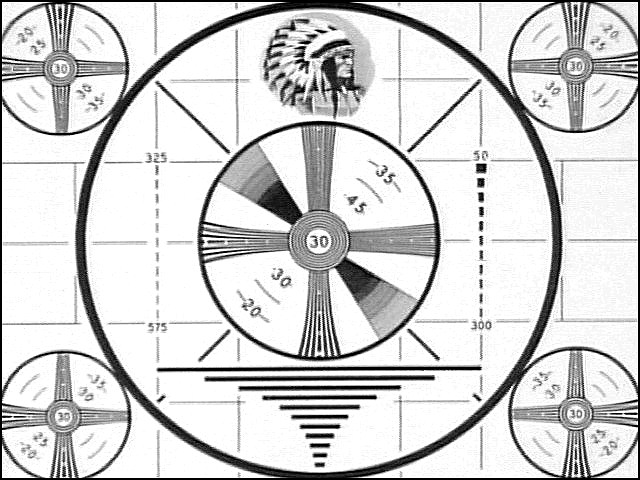
test pattern looks like. I am sometimes amazed at the ability of television to create dramatic-sounding teasers promoting the evening newscast out of thin air.
The second factor is the eyes of the beholder. Those who find it hard to believe that crime is actually down significantly are probably in their mid 30's and beyond. You get older, and the world is going to heck in a hand basket. Those police blotter articles are all the proof you need.
Kids nowadays.... I have a feeling if you polled young people, their perceptions about crime trends and community safety would be quite a bit different. They haven't been around long enough to get good and cynical yet.