

Monday, August 15, 2011
Call for assistance
I've been on a short vacation with Tonja, celebrating our anniversary. I snapped this photo in Parker, Colorado. While I don't like using 911 for anything but emergencies, you've got to admire the business plan behind these vehicle graphics.

Thursday, August 11, 2011
Bigger jam
Football traffic has been the theme this week, but yesterday was a good reminder of a looming traffic jam that will make a home football game look tame in comparison: the Guardians of Freedom airshow. This is going to be a marvelous three day event, beginning with a private show for people with disabilities on September 9, then a public show on the 10th and 11th.
If you’ve never seen the Blue Angels, you’re in for a rare treat. I love airshows, and this one will be over the top. The last time Lincoln hosted an airshow, the crowds were large and the traffic was immense. This show should draw an even bigger audience—not to mention the complication of a University Nebraska home football game on the same day.
Yesterday, there was a large fully-functional exercise involving all the key players: Airport Authority, police, fire, military, emergency management, and so forth. Scores of personnel and equipment were involved. This follows a large table-top exercise conducted at the Health Department last month. A full years’ planning has gone into the event—more than anything I’ve seen during my career other than last summer’s national Special Olympics.
Despite the planning, however, we are at the mercy of geography. No amount of advance planning and no quantity of soldiers, airmen, police officers, deputy sheriffs, state troopers, and volunteers can overcome the reality that there are only a handful of lanes that can get you into and out of the airshow.
Based on past experience, I don’t look for this to be an insurmountable problem for the pre-show arrival. After the show, however, when everyone seems to want to leave at the same time, the delays will be long. We will do our best, but you’d be well-advised to plan on a relaxed mosey after the show. Stick around and spend some time at the static displays. Pack a picnic. Have a blast, and then avoid the frustration of the peak traffic.

We’ll need to take the opportunity next month to update this photo with our latest patrol car graphics!
If you’ve never seen the Blue Angels, you’re in for a rare treat. I love airshows, and this one will be over the top. The last time Lincoln hosted an airshow, the crowds were large and the traffic was immense. This show should draw an even bigger audience—not to mention the complication of a University Nebraska home football game on the same day.
Yesterday, there was a large fully-functional exercise involving all the key players: Airport Authority, police, fire, military, emergency management, and so forth. Scores of personnel and equipment were involved. This follows a large table-top exercise conducted at the Health Department last month. A full years’ planning has gone into the event—more than anything I’ve seen during my career other than last summer’s national Special Olympics.
Despite the planning, however, we are at the mercy of geography. No amount of advance planning and no quantity of soldiers, airmen, police officers, deputy sheriffs, state troopers, and volunteers can overcome the reality that there are only a handful of lanes that can get you into and out of the airshow.
Based on past experience, I don’t look for this to be an insurmountable problem for the pre-show arrival. After the show, however, when everyone seems to want to leave at the same time, the delays will be long. We will do our best, but you’d be well-advised to plan on a relaxed mosey after the show. Stick around and spend some time at the static displays. Pack a picnic. Have a blast, and then avoid the frustration of the peak traffic.

We’ll need to take the opportunity next month to update this photo with our latest patrol car graphics!
Wednesday, August 10, 2011
Cost per game
Last weekend, a correspondent to the Lincoln Journal Star wrote a letter to the editor bemoaning the fact that the University of Nebraska does not foot the City’s bill for the cost of traffic control at UNL events, such as home football games.
The letter stimulated some additional correspondence from another citizen with some of the City Council members. This latter correspondent also incorrectly believed that the City is typically reimbursed when dignitaries visit Lincoln and require traffic/crowd control or security. Here is a response I sent to clarify the situation:
The letter stimulated some additional correspondence from another citizen with some of the City Council members. This latter correspondent also incorrectly believed that the City is typically reimbursed when dignitaries visit Lincoln and require traffic/crowd control or security. Here is a response I sent to clarify the situation:
“Councilman Emery copied me in on this thread just now, and I thought I might clarify a few things.
First of all, football games are the only UNL events for which the police department incurs overtime expenses. Any LPD officers who are engaged in basketball, baseball, or other UNL events are off duty, and being paid by UNL.
Last year, LPD spent $38,325.49 on police overtime for traffic control surrounding UNL football. This has been cut in half over the past several years, as we have reduced the number of officers involved in directing traffic. That works out to about $5,500 per home game. We are not responsible for crowd control in the stadium, which is the job of the University Police Department, but the traffic on City streets is our responsibility, and I think that's how UNL views it: your streets, your problem, your cost.
As Councilman Emery notes, it's a huge economic engine, and although I have discussed this with mayors and councils over the past five administrations, no one has been particularly interested in drawing a line in the sand. Really, the only leverage we have would be to threaten to stop directing traffic, and I suspect the egg would be on our face if we did that, not on the University's.
UNL also pays the going rate for the Lincoln Fire & Rescue medical standby at Memorial Stadium.
To the best of my knowledge, we have never received any kind of reimbursement for expenses incurred in Presidential and Vice Presidential visits to Lincoln, although I can only recall one of those (Dick Cheney, 2004) in the past 20 years. If memory serves me, that cost us close to $32,000. We have occasionally provided some security services to other visiting dignitaries, but these have been low-key events involving only a handful of officers--usually one or two.”
Monday, August 8, 2011
This will be interesting
On several past occasions on my blog, I have explained my positive experiences with roundabouts. For one reason or another, people in Lincoln still seem a little skittish about this form of intersection, despite the overwhelming evidence that they have reduced collisions and improved traffic flow.
Well, we have a pair of new ones about to open, which will immediately be put to the test. The acid test, as in around 85,000 football fans coming and going to the University of Nebraska’s Memorial Stadium at the September 3 season opener for the Cornhusker football team.
Even I, defender of roundabouts that I have been, am waiting to see how this works out. I trust those engineers, because experience tells me that they are almost always right about such matters, but somewhere back in the dark recesses of my mind rest a lot of memories of herding cats at UNL football games.
Officer Aaron Moore made a remark to me one day that added a new phrase to my vocabulary. He had about a decade of experience handling one 10th and O Street on game days, one of the busiest intersections in the City. The overpass there was closed one year for construction. One leg of this massive arterial simply dropped off the edge of the earth. We all knew it would be an interesting season for Aaron and his colleagues at 10th and O. After the first game, I asked him how it went. He said that people kept pulling up to the intersection, coming to a full stop, completely befuddled about what to do next, just staring at the barricades “like a cow looking at a new gate.” You’ve got to love that Nebraska-ism, which I have oft repeateded, usually garnering a perplexed look from the city slickers in the audience.
We shall see how the drivers deal with this new gate in a few weeks.
Well, we have a pair of new ones about to open, which will immediately be put to the test. The acid test, as in around 85,000 football fans coming and going to the University of Nebraska’s Memorial Stadium at the September 3 season opener for the Cornhusker football team.
Even I, defender of roundabouts that I have been, am waiting to see how this works out. I trust those engineers, because experience tells me that they are almost always right about such matters, but somewhere back in the dark recesses of my mind rest a lot of memories of herding cats at UNL football games.
Officer Aaron Moore made a remark to me one day that added a new phrase to my vocabulary. He had about a decade of experience handling one 10th and O Street on game days, one of the busiest intersections in the City. The overpass there was closed one year for construction. One leg of this massive arterial simply dropped off the edge of the earth. We all knew it would be an interesting season for Aaron and his colleagues at 10th and O. After the first game, I asked him how it went. He said that people kept pulling up to the intersection, coming to a full stop, completely befuddled about what to do next, just staring at the barricades “like a cow looking at a new gate.” You’ve got to love that Nebraska-ism, which I have oft repeateded, usually garnering a perplexed look from the city slickers in the audience.
We shall see how the drivers deal with this new gate in a few weeks.
Thursday, August 4, 2011
Brief me where I am
Every day at Lincoln Fire & Rescue, a short conference phone call is held, connecting all the fire stations. Special events, assignments, upcoming training, and similar information is exchanged in about 10 minutes.
Ten times every day, a similar briefing is held at Lincoln Police Department HQ. It happens 10 times daily because of the variety of overlapping shift schedules. It’s the same kind of information as at LF&R, with some highlights added about such things as recent crimes and persons-of-interest.
Beginning in the summer of 2005, LPD started using web conferencing (gotomeeting.com) to conduct the shift briefing, as a means of getting the content of the duty commander’s computer monitor out to the substations where around 95 employees begin their workday. It has worked splendidly. No one really needs to see the shift commander’s smiling face, but everyone needs to see the photo of the stolen 2009 Mitsubishi Eclipse, the map of the most recent street robberies, and the mug shot of the dangerous suspect that is on the loose.
This year, as we have been deploying our new location-based services application, P3i, we have also been loading gotomeeting’s mobile application on the iPhones and iPads. With a broadband connection on your laptop, or with an iPhone or iPad, you can join the shift briefing (we call it “lineup”) remotely. I’ve been doing that regularly for years on my laptop from home or on the road, but about a year ago I switched mostly to using the iPad app. The latest version works on both iPad and iPhone, and I tried it out this week for the first time on my phone. It worked fine, and the small screen was not much of an issue for the types of things Capt. Jim Davidsaver was covering during the briefing.
Daily shift briefings like this are occurring nationwide (actually, worldwide) in police departments. I predict that in the future, lineup will be a quaint anachronism, and the virtual meeting or web conference will be the primary means by which this information exchange is accomplished. It just makes sense.
Ten times every day, a similar briefing is held at Lincoln Police Department HQ. It happens 10 times daily because of the variety of overlapping shift schedules. It’s the same kind of information as at LF&R, with some highlights added about such things as recent crimes and persons-of-interest.
Beginning in the summer of 2005, LPD started using web conferencing (gotomeeting.com) to conduct the shift briefing, as a means of getting the content of the duty commander’s computer monitor out to the substations where around 95 employees begin their workday. It has worked splendidly. No one really needs to see the shift commander’s smiling face, but everyone needs to see the photo of the stolen 2009 Mitsubishi Eclipse, the map of the most recent street robberies, and the mug shot of the dangerous suspect that is on the loose.
This year, as we have been deploying our new location-based services application, P3i, we have also been loading gotomeeting’s mobile application on the iPhones and iPads. With a broadband connection on your laptop, or with an iPhone or iPad, you can join the shift briefing (we call it “lineup”) remotely. I’ve been doing that regularly for years on my laptop from home or on the road, but about a year ago I switched mostly to using the iPad app. The latest version works on both iPad and iPhone, and I tried it out this week for the first time on my phone. It worked fine, and the small screen was not much of an issue for the types of things Capt. Jim Davidsaver was covering during the briefing.
Daily shift briefings like this are occurring nationwide (actually, worldwide) in police departments. I predict that in the future, lineup will be a quaint anachronism, and the virtual meeting or web conference will be the primary means by which this information exchange is accomplished. It just makes sense.
Tuesday, August 2, 2011
Second murder
Lincoln's second murder of the year occurred over the weekend in the wee hours Sunday morning at a house party in the Southeast Team area. This isn't the first time someone has been murdered at a party. Whenever we can show results like this, you can be assured that the collateral splatter has been reduced, as well. Too bad we didn't get to this one before the lead flew. An unfortunate end to a young man's life, but at least nice work by the officers got this homicide cleared up quickly.
Friday, July 29, 2011
Thursday, July 28, 2011
Map happy
Most readers know that I am a bit of a GIS wonk. I now have my hands on a new set of data, and a new range of questions. Capt. Julio Talero is the GIS analyst at Lincoln Fire & Rescue, but I can’t help by dabbling a little myself on the weekends. I leave the heavy lifting to him, but I can play a little, too.
In preparation for a meeting last week, I prepared a few simple slides for my iPad. Capt. Talero provided me with a set of four-minute travel time polygons. Using ESRI’s ArcGIS and Network Analyst extension, he created these polygons, which represent coverage areas from each fire station within four minutes of hypothetical travel time: hypothetical because the method uses the speed limit of each street segment to perform the calculation. In the real world, you don’t get a running start, your acceleration is not exactly like a Cobra 429, and there are plenty of motorists who either can’t hear your siren over their music, or freeze up in the inside lane.
This first map shows the location of the stations, and the four-minute polygon surrounding. There is a lot of overlap, and these 14 polygons are opaque: they are layered over or under the adjacent station’s four minute area.

Overlap is good if it’s located in the right place: the areas where you are most likely to have a high volume of calls for service. If you want to have a reasonable response time to every address in the City, you have to consider both proximity to the fire station, AND the likelihood that the resources at that station are already committed. In a busy area, the resources are more likely to be occupied elsewhere, so the response is not coming from the closest station anyway. Here’s another map depicting the overlap areas:
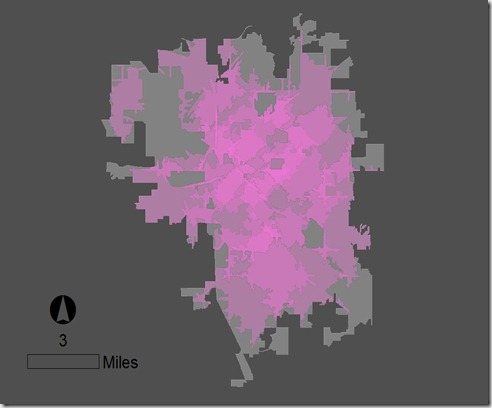
In this map, each of the 14 polygons is shaded pink and semi-transparent. As four-minute travel time areas overlap, the visual effect is that the color becomes more and more opaque—a hotter shade of pink.
In preparation for a meeting last week, I prepared a few simple slides for my iPad. Capt. Talero provided me with a set of four-minute travel time polygons. Using ESRI’s ArcGIS and Network Analyst extension, he created these polygons, which represent coverage areas from each fire station within four minutes of hypothetical travel time: hypothetical because the method uses the speed limit of each street segment to perform the calculation. In the real world, you don’t get a running start, your acceleration is not exactly like a Cobra 429, and there are plenty of motorists who either can’t hear your siren over their music, or freeze up in the inside lane.
This first map shows the location of the stations, and the four-minute polygon surrounding. There is a lot of overlap, and these 14 polygons are opaque: they are layered over or under the adjacent station’s four minute area.

Overlap is good if it’s located in the right place: the areas where you are most likely to have a high volume of calls for service. If you want to have a reasonable response time to every address in the City, you have to consider both proximity to the fire station, AND the likelihood that the resources at that station are already committed. In a busy area, the resources are more likely to be occupied elsewhere, so the response is not coming from the closest station anyway. Here’s another map depicting the overlap areas:

In this map, each of the 14 polygons is shaded pink and semi-transparent. As four-minute travel time areas overlap, the visual effect is that the color becomes more and more opaque—a hotter shade of pink.
Subscribe to:
Posts (Atom)
