
I must have missed the story of chaos and carnage in the two new roundabouts near the University of Nebraska’s Memorial Stadium. Despite dire predictions from Internet pundits, it seems that a sell-out crowd managed to attend last Saturday’s season-opener for the Cornhusker football team without any bodies being left in the road.
Having driven the twin-twin rounbabouts (two in a row, double lanes) several times now, I have concluded that navigating them is just pretty natural. If you want to got right, you get in the right lane; left or u-ball, left lane; straight ahead, take your pick.
Still, with 85,000 fans coming and going, along with an untold number of dalliers, hangers-on, and tailgaters without tix—I thought it might be a better show than it turned out to be. The season, however, is still young.
Thursday, September 8, 2011
Tuesday, September 6, 2011
Not that bad
Over the weekend a guest column ran in the Lincoln Journal Star, about which I have mixed emotions. On the one hand, I appreciate citizen awareness and support. On the other hand, the column was a little, shall we say, alarmist. The author suggested that Lincoln's crime rate is higher than the last two places she has lived: New York City, and Martin County, Florida.
Not so fast. As readers of the Director's Desk should know, the long term crime trend in Lincoln is down, and way down, since peaking in 1991. I cannot find a website named crimeratecomparison.com that the writer refers to in her column, but the most recent published national crime data is the 2009 Uniform Crime Report from the FBI. 2010's preliminary report is out, but the final report will be published this fall. In the 2009 UCR.
New York City's violent crime rate was 552 per 100,000.
Lincoln's violent crime rate was 458 per 100,000.
New York City's property crime rate was 1,670 per 100,000.
Lincoln's property crime rate was 3,933 per 100,000.
New York is a very safe city--among the safest big cities. Lincoln's violent crime rate, though, is significantly lower than New Yorks, and in the bottom third of cities within 50,000 either way of our population. While our property crime rate is significantly higher than New York's, 80% of those Lincoln property crimes are the most minor category: larceny/theft. I suspect that most, if not all of the difference is a reporting phenomenon. Call the New York City Police Department and report that the Sunday New York Times was stolen from your front porch. This will be an interesting experiment. Let's see if that results in an official police crime report for larceny/theft. I guarantee it would in Lincoln. In fact, the most recent case number for a Sunday Journal Star stolen from a front porch is B0-107175. We had to fend off a few such reports when the Journal Star's printing press crashed on June 11.
As for Martin County, Florida, the FBI doesn't publish crime rates for counties, but the largest city in Martin County is Stuart, population 16,000. The 2009 violent crime rate in Stuart was 438 per 100,000, and property crime was 4,688 per 100,000. That's pretty similar to Lincoln, although in fairness I think you'd have to compare Stuart to a like-sized Nebraska City, such as LaVista ( violent crime: 52/100,00 and property crime: 1,995/100,000).
Nonetheless, I appreciate this writer's support and agree wholeheartedly that "taking care of the small stuff" helps prevent the big stuff. This was a mantra at LPD when Rudy Giuliani and I were attending different secondary schools together. I would challenge anyone to find a municipal police department of 321 officers who arrests people for 26,972 charges--as Lincoln did in 2010. I will put our arrest productivity up against anyone, anytime, anywhere. This is a bad City to live in if you're a chronic rider-of-bicycles-upon-downtown-sidewalks.
While she overstates the case, the call to awareness and action is always a good one. Watchful citizens are even more important than plentiful police officers in preventing crime. I think when people get the impression that crime in Lincoln is way up, it is a result of ubiquitous news media coverage of crime (scroll all the way to the bottom, or you'll die of boredom).
On second thought, you best not call NYPD to report the Times stolen: that would be filing a false police report.
Not so fast. As readers of the Director's Desk should know, the long term crime trend in Lincoln is down, and way down, since peaking in 1991. I cannot find a website named crimeratecomparison.com that the writer refers to in her column, but the most recent published national crime data is the 2009 Uniform Crime Report from the FBI. 2010's preliminary report is out, but the final report will be published this fall. In the 2009 UCR.
New York City's violent crime rate was 552 per 100,000.
Lincoln's violent crime rate was 458 per 100,000.
New York City's property crime rate was 1,670 per 100,000.
Lincoln's property crime rate was 3,933 per 100,000.
New York is a very safe city--among the safest big cities. Lincoln's violent crime rate, though, is significantly lower than New Yorks, and in the bottom third of cities within 50,000 either way of our population. While our property crime rate is significantly higher than New York's, 80% of those Lincoln property crimes are the most minor category: larceny/theft. I suspect that most, if not all of the difference is a reporting phenomenon. Call the New York City Police Department and report that the Sunday New York Times was stolen from your front porch. This will be an interesting experiment. Let's see if that results in an official police crime report for larceny/theft. I guarantee it would in Lincoln. In fact, the most recent case number for a Sunday Journal Star stolen from a front porch is B0-107175. We had to fend off a few such reports when the Journal Star's printing press crashed on June 11.
As for Martin County, Florida, the FBI doesn't publish crime rates for counties, but the largest city in Martin County is Stuart, population 16,000. The 2009 violent crime rate in Stuart was 438 per 100,000, and property crime was 4,688 per 100,000. That's pretty similar to Lincoln, although in fairness I think you'd have to compare Stuart to a like-sized Nebraska City, such as LaVista ( violent crime: 52/100,00 and property crime: 1,995/100,000).
Nonetheless, I appreciate this writer's support and agree wholeheartedly that "taking care of the small stuff" helps prevent the big stuff. This was a mantra at LPD when Rudy Giuliani and I were attending different secondary schools together. I would challenge anyone to find a municipal police department of 321 officers who arrests people for 26,972 charges--as Lincoln did in 2010. I will put our arrest productivity up against anyone, anytime, anywhere. This is a bad City to live in if you're a chronic rider-of-bicycles-upon-downtown-sidewalks.
While she overstates the case, the call to awareness and action is always a good one. Watchful citizens are even more important than plentiful police officers in preventing crime. I think when people get the impression that crime in Lincoln is way up, it is a result of ubiquitous news media coverage of crime (scroll all the way to the bottom, or you'll die of boredom).
On second thought, you best not call NYPD to report the Times stolen: that would be filing a false police report.
Thursday, September 1, 2011
P3i for public
Our new location-based service application, P3i (Proactive Police Patrol information) is now in the Apple iTunes store and the Android Marketplace. The public version is just like our internal police-only version, except the data available to the user is different. For the general public, it is a sanitized subset of police incident reports in the past 30 days: crimes like burglary, theft, robbery, vandalism, and assault—with the exact address and personal identifiers redacted.
You will be able to see the incident reports of this type near your current location as you move(within Lincoln), based on the GPS position reported by your device. The app will give you some insight into the capabilities the officers have with the application and you can imagine the full-fledged police-only data that displays on their devices.
On a related note, the Omega Group, our longtime crime mapping software vendor, has recently released a mobile version of crimemapping.com for iPhone. The app is very similar to the public version of P3i. Just as with the regular browser version of crimemapping.com, you can sign up for Crime Alerts—something anyone who lives in Lincoln or any other community served by crimemapping.com should definitely do. I’m subscribed to my own address in Lincoln, and to my daughter’s in Omaha, and even though I swim in the stream of police incident reports and daily briefings, I often find out about crime in my own neighborhood through Crime Alerts.
Tuesday, August 30, 2011
No monopoly on hate
It’s a new semester, and invitations to speak at various University of Nebraska classes have begun. Last year, I blogged about a visit to ALEC 466: Agricultural Leadership and Communication, Leadership and Diversity. The instructor, PhD student Helen Fagan, gave me a couple of broad topics, racial profiling and hate crimes.
I’m hardly and expert, but it seemed to be a good discussion, like last year. Perhaps my years of experience in policing provide a certain viewpoint that contributes to the students’ learning process. I took along a few Incident Reports that are typical examples of hate crimes in Lincoln.
The reports (13 in all) are a depressing testament to, hate, racism, and just plain ugliness: an assault outside a McDonalds on a man who couldn’t restrain himself when he felt the customers ahead of him were moving too slow, and who couldn’t refrain from making his report to the police laced with disgusting, racist language; a gay couple’s window smashed out with a brick; a Latino couple accosted by an Asian man with an incredible barrage of hateful, racist language; a racially-charged fight at a high school: a car load of bigots looking for a victim to torment outside a gay bar. Remarkable, however, was the racial and ethnic diversity of both perpetrators and victims, proving that no one has a monopoly on hate.
As I reminded the students, this snapshot of a few police reports is just the tip of a much larger iceberg.
Wednesday, August 24, 2011
LF&R debriefings
One of the really good things I’ve discovered at Lincoln Fire & Rescue as I’ve learned more about the operations is a common practice of conducting both formal and informal after-action-reviews of major incidents.
Due to a conflict, I couldn’t attend the debriefing following this year’s largest fire (Lincoln Public Schools Administration Building), but recnetly I sat in on a short review of a structure fire that occurred on July 5th on SW 10th Street. Battalion Chief Dean Staberg conducted the review. It was a nice assessment of what worked, what didn’t, and lessons learned.
A self-critique like this is a marvelous process for an organization to adopt. It is particularly valuable when the goal is to share information in a collegial setting aimed at performance improvement, not in second-guessing or blaming. I’d like to see more of this on the police side of public safety in Lincoln.
Here’s one simple tidbit, for example, that I picked up: rather than referring to the faces of a basically-rectangular structure by their compass point, LF&R designates them by letters: A, B, C and D (Alpha, Bravo, Charlie, and Delta). The letters are assigned clockwise beginning with the main face where the address would be. This way, no one has to guess about the compass directions, which are often unclear in the dark, on winding streets, and when buildings are not oriented north-and-south. My house is a pretty good example: here’s the aerial photo. In this image, north is straight up. What would you call the side with the deck and patio? The north side? The west side? LF&R would call it the Charlie side--simply and effectively eliminating any confusion.
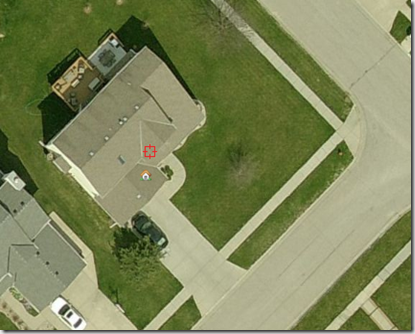
Due to a conflict, I couldn’t attend the debriefing following this year’s largest fire (Lincoln Public Schools Administration Building), but recnetly I sat in on a short review of a structure fire that occurred on July 5th on SW 10th Street. Battalion Chief Dean Staberg conducted the review. It was a nice assessment of what worked, what didn’t, and lessons learned.
A self-critique like this is a marvelous process for an organization to adopt. It is particularly valuable when the goal is to share information in a collegial setting aimed at performance improvement, not in second-guessing or blaming. I’d like to see more of this on the police side of public safety in Lincoln.
Here’s one simple tidbit, for example, that I picked up: rather than referring to the faces of a basically-rectangular structure by their compass point, LF&R designates them by letters: A, B, C and D (Alpha, Bravo, Charlie, and Delta). The letters are assigned clockwise beginning with the main face where the address would be. This way, no one has to guess about the compass directions, which are often unclear in the dark, on winding streets, and when buildings are not oriented north-and-south. My house is a pretty good example: here’s the aerial photo. In this image, north is straight up. What would you call the side with the deck and patio? The north side? The west side? LF&R would call it the Charlie side--simply and effectively eliminating any confusion.

Monday, August 22, 2011
New blog
Andrew Dasher is the manager of the Lincoln Police Department's Crime Analysis Unit. Drew has a new blog, locationbasedpolicing.com. He is interested in engaging more of his colleagues in a dialog about the emerging technology of location-based services in policing, and the implications of this technology for police strategies.
I was really intrigued with his most recent post about a free geocoding and map hosting service, batchgeo. It amazes me what you can do these days with free products and services. Drew has published a sample map of a fictional series of auto thefts, to demonstrate the output from batchgeo. Click on one of the fake cases, and check out the cool label that incorporates an image. I can write the string of html code necessary to create the labels in Drew's sample map, but this product automates that to a very easy pick-and-click step. There simply is no reason any police or fire agency with the inclination couldn't be creating some useful GIS products.
Good luck with the blog, Drew. This is certainly a topic that is gathering a lot of momentum in policing, and if you can stimulate some more discussion among crime analysts and policing practitioners, you will be performing a nice service to the professional field.
I was really intrigued with his most recent post about a free geocoding and map hosting service, batchgeo. It amazes me what you can do these days with free products and services. Drew has published a sample map of a fictional series of auto thefts, to demonstrate the output from batchgeo. Click on one of the fake cases, and check out the cool label that incorporates an image. I can write the string of html code necessary to create the labels in Drew's sample map, but this product automates that to a very easy pick-and-click step. There simply is no reason any police or fire agency with the inclination couldn't be creating some useful GIS products.
Good luck with the blog, Drew. This is certainly a topic that is gathering a lot of momentum in policing, and if you can stimulate some more discussion among crime analysts and policing practitioners, you will be performing a nice service to the professional field.
Friday, August 19, 2011
Make ‘em pay!
Another citizen emailed the Mayor expressing dismay that the City of Lincoln doesn’t make the University pay for traffic control surrounding UNL home football games. This writer SENT HIS MESSAGE IN ALL CAPS and held up the example of Ann Arbor, Michigan, home of the University of Michigan. The Mayor’s Office asked me to respond on behalf of the administration, which required just a slight rewrite of last week’s response to another correspondent.
Don’t think we’d win the case in the court of public opinion, if we took our whistles and went home. Maybe I’m wrong, though.
Don’t think we’d win the case in the court of public opinion, if we took our whistles and went home. Maybe I’m wrong, though.
Thursday, August 18, 2011
Urban legend circulating
One of the downsides of the Internet and email has been the rapidity with which unfounded rumors and urban legends spread. Within the past ten days, three people have forwarded this email to me. It is always passed on by a credible person who is familiar with this situation right here in Lincoln!
“This message is or any lady who goes to work, college or school or even driving or walking the streets alone. If you find a young person crying on the road showing you their address and is asking you to take them to that address... Take that child to the POLICE STATION!! No matter what you do, DON'T go to that address. This is a new way for gang members (MS13) to rape women. Please forward this message to all ladies & guys so that they can inform their sisters & friends and family. Please don't feel shy to forward this message. Thank you!”
I have told all the correspondents that this is a urban legend and has no credence whatsoever. Not that it’s entirely bad advice, however. Better yet, though, why not just call the police?
Not the first urban legend I’ve dealt with on the Director’s Desk, and sometimes an email circulates that has all the appearances of an urban legend, but is actually quite true. When I see something fishy like this, I generally search snopes.com with a few keywords, like: child | crying | gang | rape. It is amazing how often the story is not only the same, but even the wording is nearly identical to something that first popped up on the web years ago.
Subscribe to:
Posts (Atom)
