
On short notice yesterday, I was asked to come over to the Mayor’s weekly news conference, where graffiti abatement was on the agenda. William Carver of the Health Department, who coordinates the City’s graffiti abatement efforts, was the main attraction, but the Mayor also wanted to mention arrests for vandalism involving graffiti.
I had to scramble to put some data together, and I found it rather interesting. So far this year, 445 graffiti cases have been reported to the police. Of those, 69 cases have been cleared with an arrest—quite a few more than I would have expected. Some of those arrested, however, were prolific offenders whose arrest solved several cases.
The total number of arrests was 23, five of whom were adults, the remainder juveniles. The ages range from 10 to 57. A third of them were 14 year olds. I have no easy way of knowing what has become of the cases that were referred to juvenile court, but for the five arrests that went through adult court, the outcomes are as follows: one case is still pending, the offender has been convicted and is awaiting sentencing on September 10; one case resulted in a 30 day jail sentence (note: do not tag a church!); three cases resulted in $250 fines, and two of the three defendants who were fined have failed to pay their fines, resulting in the issuance of arrest warrants for that pair.
Mr. Carver is pretty familiar with the various tagging crews who are active in the Lincoln area, and he has a database of graffiti that is searchable by tag. The purpose of the news conference was for the Mayor to highlight the City’s success in keeping up with this crime, and William is the main cog that makes that apparatus successful.
Friday, July 30, 2010
Thursday, July 29, 2010
Special thanks
The afterglow of the Special Olympics national games is mighty pleasant for Lincoln. This has been the City’s finest moment in my recollection, and I am glad we could be a part of it.
Capt. Brian Jackson managed LPD’s official role in the games, but the volunteer effort was huge part of the story. Over 85 Lincoln police employees volunteered for the Special Olympics. We had a few people who took the entire week off on vacation so they could donate their time and work through the games. It is impossible for me to thank them each individually in this post, but they all deserve props.
I would like to take a moment, though, to express my thanks to two people in particular, both long time advocates, cheerleaders, and fundraisers for Special Olympics. They would be the first to pass the credit along, so rather than being embarrassed by this, they can just consider themselves as representatives of all the other volunteers, too.
Retired Sgt. Jerry Thraen coordinated logistics for the 2010 games. He did a phenomenal job, recruiting and scheduling scores of volunteers from dozens of law enforcement agencies to cover each venue and make sure any safety and security needs were handled. He also handled transportation and other logistics for the games. Jerry got many deputies, officers, and troopers—both active duty and retired—involved in a memorable week of service that they will not soon forget. Jerry has been involved in Special Olympics on the local, national and international scene, for twenty five years.
Sgt. Jeri Roeder coordinated the Torch Run for the 2010 games, a major undertaking. The Law Enforcement Torch Run is the largest grassroots fundraising effort for the Special Olympics, and Jeri did a great job spearheading the multi-state final leg for the national games. She coordinated the runners, the althletes, the schedules, the routes, the support vehicles and personnel, the community events, and the media relations and publicity for the Torch Run. She has been a tireless, dedicated worker for Special Olympics for many years through all sorts of clever promotions—Tip a Cop, Cop on Top, Cops n‘ Lobsters, Polar Plunge, to name a few.
Now there’s a couple of tired cops for you, recuperating from the capstone experience of a multi-year effort for an event on the national stage.
Jerry, Jeri, my hat is off to the two of you, and everyone else who made this such an incredible event for Lincoln and for the athletes and their families!
Capt. Brian Jackson managed LPD’s official role in the games, but the volunteer effort was huge part of the story. Over 85 Lincoln police employees volunteered for the Special Olympics. We had a few people who took the entire week off on vacation so they could donate their time and work through the games. It is impossible for me to thank them each individually in this post, but they all deserve props.
I would like to take a moment, though, to express my thanks to two people in particular, both long time advocates, cheerleaders, and fundraisers for Special Olympics. They would be the first to pass the credit along, so rather than being embarrassed by this, they can just consider themselves as representatives of all the other volunteers, too.
Retired Sgt. Jerry Thraen coordinated logistics for the 2010 games. He did a phenomenal job, recruiting and scheduling scores of volunteers from dozens of law enforcement agencies to cover each venue and make sure any safety and security needs were handled. He also handled transportation and other logistics for the games. Jerry got many deputies, officers, and troopers—both active duty and retired—involved in a memorable week of service that they will not soon forget. Jerry has been involved in Special Olympics on the local, national and international scene, for twenty five years.
Sgt. Jeri Roeder coordinated the Torch Run for the 2010 games, a major undertaking. The Law Enforcement Torch Run is the largest grassroots fundraising effort for the Special Olympics, and Jeri did a great job spearheading the multi-state final leg for the national games. She coordinated the runners, the althletes, the schedules, the routes, the support vehicles and personnel, the community events, and the media relations and publicity for the Torch Run. She has been a tireless, dedicated worker for Special Olympics for many years through all sorts of clever promotions—Tip a Cop, Cop on Top, Cops n‘ Lobsters, Polar Plunge, to name a few.
Now there’s a couple of tired cops for you, recuperating from the capstone experience of a multi-year effort for an event on the national stage.
Jerry, Jeri, my hat is off to the two of you, and everyone else who made this such an incredible event for Lincoln and for the athletes and their families!
Tuesday, July 27, 2010
Trouble in the Valley?
I blogged about my Father’s Day bike ride with my daughter a couple of months ago, and since that time the ride through the Antelope Valley trail has become part of my regular routine. I’m down the trail at least three times a week. So when I read this column in the Sunday paper, I had a pretty good visual.
I usually take my rides between 5:30 and 7:00 AM. Most days, there are two or three men sleeping under the bridges at N, O, P, or Q Streets. I’ve seen a few small items of clothing or food packaging left behind. Like any other urban watercourse, Antelope Creek carries the flotsam and jetsam of trash that washes down four miles below Holmes Lake. Plastic bottles and tennis balls bob in the tepid pool that forms between J Street and the weir. Someone is obviously collecting it from time to time.
I have yet to see anyone drinking, but that is probably a function of the time of day I am there. It’s not exactly cocktail hour. I can’t imagine that it isn’t a problem from time to time later in the day. I walked it this afternoon, and everything looked pretty good. The area under the bridges is shaded, clean, has a ledge at the top, is out of the rain and dew, has attractive lighting, is out-of-view from the roadways above, and is a stone’s throw from a liquor store and the People’s City Mission distribution center.
While the author of the column hasn’t seen any police officers during his strolls, we are indeed spending a little time in the Valley. The best we can do as a police department is try to keep the illegal behavior—nudity, public urination and defecation, drinking alcohol in public, unlawful panhandling, and so forth—somewhat in check through judicious application of a little patrol, surveillance and enforcement.
Build it, and they will come. If I had designed it, here’s something you would not see at all beneath those bridges: a flat spot.
I usually take my rides between 5:30 and 7:00 AM. Most days, there are two or three men sleeping under the bridges at N, O, P, or Q Streets. I’ve seen a few small items of clothing or food packaging left behind. Like any other urban watercourse, Antelope Creek carries the flotsam and jetsam of trash that washes down four miles below Holmes Lake. Plastic bottles and tennis balls bob in the tepid pool that forms between J Street and the weir. Someone is obviously collecting it from time to time.
I have yet to see anyone drinking, but that is probably a function of the time of day I am there. It’s not exactly cocktail hour. I can’t imagine that it isn’t a problem from time to time later in the day. I walked it this afternoon, and everything looked pretty good. The area under the bridges is shaded, clean, has a ledge at the top, is out of the rain and dew, has attractive lighting, is out-of-view from the roadways above, and is a stone’s throw from a liquor store and the People’s City Mission distribution center.
While the author of the column hasn’t seen any police officers during his strolls, we are indeed spending a little time in the Valley. The best we can do as a police department is try to keep the illegal behavior—nudity, public urination and defecation, drinking alcohol in public, unlawful panhandling, and so forth—somewhat in check through judicious application of a little patrol, surveillance and enforcement.
Build it, and they will come. If I had designed it, here’s something you would not see at all beneath those bridges: a flat spot.
Monday, July 26, 2010
The illegal dilemma
Illegal immigration is an incendiary issue in the United States these days. Last week, I was correctly quoted (mainly) in a short news article that summed up a two-hour meeting I attended with the Mayor’s Multicultural Advisory Committee. Partly through my own ill-chosen words, and partly through the filtering process that distills a long meeting into a few paragraphs, I felt as though my remarks and opinions were mischaracterized. I’m not blaming anyone but myself, though, I am just trying to clarify.
The Committee asked me to explain what our practice was regarding notifying Immigrations and Customs Enforcement when an illegal alien was arrested or contacted. They had become aware of a specific case, in which a 43 year old woman from El Salvador had been arrested for a misdemeanor by the police department, and subsequently became the subject of a deportation proceeding. She had entered the United States legally in December, 2001 with a short-term visa, and was arrested by LPD for identity fraud after she tried to open a bank account under an assumed name with fake ID.
I explained that the fingerprint record of the arrest was submitted to the Federal government, as prints have been for decades. In this particular case, the record matched an ICE database record on a person who had overstayed her visa by more than 8 years. The existence of these databases, and the rapidity with which such comparisons can be made makes these kinds of matches much faster and more likely today than in the past. We hadn’t gone out of our way to bring the weight of the Federal system down upon her at all—she merely was discovered by ICE in the ordinary course of business. We did our job, ICE did theirs, and that’s the way it is supposed to be.
Some of the members of the Committee, however, had been concerned that the Lincoln Police Department had signed up for a Federal program by which selected local law enforcement officers are trained to initiate immigration proceedings, the Section 287 program. We have not, and I am not interested in investing our resources in this manner. Having just lost 6 front line staff in the budget process, I assure you we have plenty to do without assuming work that is vested by the Constitution in the Federal government and is the statutory responsibility of a Federal agency. In explaining this to the committee, I said something to the effect of “I’m not interested in helping the Federal government do its job.” Bad way to be quoted, although that is in fact what I said, or something reasonably close to it. I was narrowly referring to signing up for the Section 287 program.
Let me set the record straight. I appreciate the work of our Federal law enforcement agencies, and we work closely with them. We both receive from, and render assistance to, Federal law enforcement agencies regularly—including ICE. Every single fingerprint record we collect for arrestees is provided to these databases, and ICE is able to check any foreign-born subject against their database. I think it is very important that we continue to do so, and I was correctly quoted on that, too. I have never, ever, declined assistance to any Federal agency.
This particular case is unusual, in that a women who—except for her obvious immigration violation--had otherwise been a law-abiding local resident got arrested for a fraud offense (I am told she needed an account for direct deposit from an employer, and was scared she would be caught by E-Verify), and was quickly detained for an immigration violation by ICE. My experience has been that trying to get someone deported is often a maddening process even when the subject has been arrested on multiple occasions and is is terrifying our community and driving the local police crazy. It takes a lot of time, and requires convictions for just-the-right-kind of crimes.
What frustrates me the most about Federal immigration policy is that local police departments are being increasingly burdened by the intransigence of our Federal officials, who are failing to come to terms with the issue, and failing to provide sufficient resources to deal with it. This women’s visa expired in February, 2002. Why wasn’t the INS looking for her years ago? She hasn’t exactly been in hiding. How much more difficult is it to send her home nine years later than it would have been in the Spring of 2002? How many other people have overstayed their visas by years, and how many of those have bought homes, had children, and otherwise sunk deep roots?
I know this is a complex issue, without easy solutions. But by continuing with the status quo, the day of reckoning is just being put off, and it gets harder with each passing day. As States like Arizona, and cities like Fremont, Nebraska pass their own laws aimed at controlling illegal immigration, local police departments are being asked to fill the void created by the Federal government’s abdication of responsibility, and their under-resourcing of the effort. This leave us between a rock and a hard place, and I don’t like that.
I have my own opinions on what might be done at the Federal level to begin to straighten this mess out. My personal opinion is similar to proposals made in the past by President Bush and by Congressman Tom Osborne. Those weren’t exactly embraced even in their own political party, but I think they were more realistic than most, and would start us on a more productive path than the one we are on, which seems to be an aimless wander down a road to nowhere.
The Committee asked me to explain what our practice was regarding notifying Immigrations and Customs Enforcement when an illegal alien was arrested or contacted. They had become aware of a specific case, in which a 43 year old woman from El Salvador had been arrested for a misdemeanor by the police department, and subsequently became the subject of a deportation proceeding. She had entered the United States legally in December, 2001 with a short-term visa, and was arrested by LPD for identity fraud after she tried to open a bank account under an assumed name with fake ID.
I explained that the fingerprint record of the arrest was submitted to the Federal government, as prints have been for decades. In this particular case, the record matched an ICE database record on a person who had overstayed her visa by more than 8 years. The existence of these databases, and the rapidity with which such comparisons can be made makes these kinds of matches much faster and more likely today than in the past. We hadn’t gone out of our way to bring the weight of the Federal system down upon her at all—she merely was discovered by ICE in the ordinary course of business. We did our job, ICE did theirs, and that’s the way it is supposed to be.
Some of the members of the Committee, however, had been concerned that the Lincoln Police Department had signed up for a Federal program by which selected local law enforcement officers are trained to initiate immigration proceedings, the Section 287 program. We have not, and I am not interested in investing our resources in this manner. Having just lost 6 front line staff in the budget process, I assure you we have plenty to do without assuming work that is vested by the Constitution in the Federal government and is the statutory responsibility of a Federal agency. In explaining this to the committee, I said something to the effect of “I’m not interested in helping the Federal government do its job.” Bad way to be quoted, although that is in fact what I said, or something reasonably close to it. I was narrowly referring to signing up for the Section 287 program.
Let me set the record straight. I appreciate the work of our Federal law enforcement agencies, and we work closely with them. We both receive from, and render assistance to, Federal law enforcement agencies regularly—including ICE. Every single fingerprint record we collect for arrestees is provided to these databases, and ICE is able to check any foreign-born subject against their database. I think it is very important that we continue to do so, and I was correctly quoted on that, too. I have never, ever, declined assistance to any Federal agency.
This particular case is unusual, in that a women who—except for her obvious immigration violation--had otherwise been a law-abiding local resident got arrested for a fraud offense (I am told she needed an account for direct deposit from an employer, and was scared she would be caught by E-Verify), and was quickly detained for an immigration violation by ICE. My experience has been that trying to get someone deported is often a maddening process even when the subject has been arrested on multiple occasions and is is terrifying our community and driving the local police crazy. It takes a lot of time, and requires convictions for just-the-right-kind of crimes.
What frustrates me the most about Federal immigration policy is that local police departments are being increasingly burdened by the intransigence of our Federal officials, who are failing to come to terms with the issue, and failing to provide sufficient resources to deal with it. This women’s visa expired in February, 2002. Why wasn’t the INS looking for her years ago? She hasn’t exactly been in hiding. How much more difficult is it to send her home nine years later than it would have been in the Spring of 2002? How many other people have overstayed their visas by years, and how many of those have bought homes, had children, and otherwise sunk deep roots?
I know this is a complex issue, without easy solutions. But by continuing with the status quo, the day of reckoning is just being put off, and it gets harder with each passing day. As States like Arizona, and cities like Fremont, Nebraska pass their own laws aimed at controlling illegal immigration, local police departments are being asked to fill the void created by the Federal government’s abdication of responsibility, and their under-resourcing of the effort. This leave us between a rock and a hard place, and I don’t like that.
I have my own opinions on what might be done at the Federal level to begin to straighten this mess out. My personal opinion is similar to proposals made in the past by President Bush and by Congressman Tom Osborne. Those weren’t exactly embraced even in their own political party, but I think they were more realistic than most, and would start us on a more productive path than the one we are on, which seems to be an aimless wander down a road to nowhere.
Friday, July 23, 2010
In the report stack
You read police reports, you find a lot of interesting material. As I have often said, you just can’t make this stuff up.
I have edited the original report somewhat to protect the identities of those involved.

I have edited the original report somewhat to protect the identities of those involved.

Thursday, July 22, 2010
Contributing to a stereotype
It’s that time of the year again, the Battle of the Badges has concluded. At yesterday’s weekly meeting of the department heads with the Mayor, the travelling trophy was to be bestowed on the winning team. The suspense was palpable. After the police team was announced as the winner, I should have been flagged for unsportsmanlike conduct—excessive celebration.
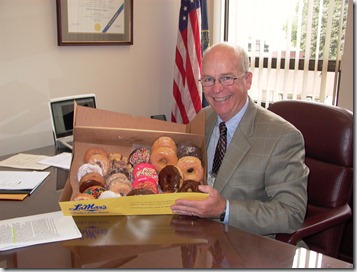
The Blood Bank representatives brought donuts to the Mayor’s office for the announcement, but only a few were consumed by the City directors. I snagged the box from the Mayor’s conference room after the meeting, brought them back to HQ and passed them around to the staff. To the victor go the spoils, as they say.
Our Team leader, Michele Selvage, grabbed the hardware, since I was busy gloating and my hands were filled with a box of bleached flour, refined sugar, and fat. All for a good cause, though. For 12 years he Battle of the Badges has brought out donors for the Community Blood Bank.
Is this photo contributing to a stereotype?
The Blood Bank representatives brought donuts to the Mayor’s office for the announcement, but only a few were consumed by the City directors. I snagged the box from the Mayor’s conference room after the meeting, brought them back to HQ and passed them around to the staff. To the victor go the spoils, as they say.
Our Team leader, Michele Selvage, grabbed the hardware, since I was busy gloating and my hands were filled with a box of bleached flour, refined sugar, and fat. All for a good cause, though. For 12 years he Battle of the Badges has brought out donors for the Community Blood Bank.
Is this photo contributing to a stereotype?

Tuesday, July 20, 2010
Special Olympics
This is old news to Lincoln readers of the Chief's Corner, but for those of you in far flung states and countries, we are hosting the National Special Olympics Games in Lincoln this week. It's quite a show, with 3,600 athletes, their coaches, families, and fans filling the city.
The Special Olympics is the signature event for police philanthropy in the United States. The Law Enforcement Torch Run is the largest grassroots fundraiser for Special Olympics, and generally coincides with each State's games. This year, with the national games in Nebraska, the torch run involved scores of law enforcement officers and Special Olympics athletes from all over the United States.
I was honored to help escort the Nebraska delegation in the parade of teams at the opening ceremonies on Sunday, and it was a memorable event. My favorite part, though, wasn't in the arena: rather, it was on the adjacent track, where the teams were assembled for the entrance, a rather complex choreography indeed. As the teams arrived, myself and several dozen police officers, troopers, and deputies from coast to coast in an array of varying uniforms shook hands, bumped fists, hugged, and high-fived athletes of every kind, type, and description.
In the process of welcoming folks to our city, I was surprised by the number of people who remarked about how nice and clean Lincoln seems. Funny, when you live here, you don't so much notice. They're right, though, it's an awfully nice place where you have to do quite a bit of looking to find the dust bunnies.
Hotter than blazes the past several days, and the heat intends to stick around for the games. Let's hope everyone stays well hydrated, and enjoys great competition, sportsmanship, and fellowship. I get to hang medals on Thursday at track & field, where I'll be looking for a little shade between events!
The Special Olympics is the signature event for police philanthropy in the United States. The Law Enforcement Torch Run is the largest grassroots fundraiser for Special Olympics, and generally coincides with each State's games. This year, with the national games in Nebraska, the torch run involved scores of law enforcement officers and Special Olympics athletes from all over the United States.
I was honored to help escort the Nebraska delegation in the parade of teams at the opening ceremonies on Sunday, and it was a memorable event. My favorite part, though, wasn't in the arena: rather, it was on the adjacent track, where the teams were assembled for the entrance, a rather complex choreography indeed. As the teams arrived, myself and several dozen police officers, troopers, and deputies from coast to coast in an array of varying uniforms shook hands, bumped fists, hugged, and high-fived athletes of every kind, type, and description.
In the process of welcoming folks to our city, I was surprised by the number of people who remarked about how nice and clean Lincoln seems. Funny, when you live here, you don't so much notice. They're right, though, it's an awfully nice place where you have to do quite a bit of looking to find the dust bunnies.
Hotter than blazes the past several days, and the heat intends to stick around for the games. Let's hope everyone stays well hydrated, and enjoys great competition, sportsmanship, and fellowship. I get to hang medals on Thursday at track & field, where I'll be looking for a little shade between events!
Monday, July 19, 2010
Final arrest
Officer Ray Kansier retired last week, after 38 years and 2 months wearing the LPD uniform. While we don’t keep records on such matters, I suspect Ray is in the top two or three in our 130+ year history on length of service for a street police officer. It’s a remarkable accomplishment.
There was a nice retirement coffee for Ray on Friday afternoon. I noted that Officer Kansier had been involved in a very nasty motorcycle accident in 1975 which would have been career ending for anyone with less grit and determination. I also noted Ray’s final arrest: this pair, for a righteous felony and a collection of misdemeanors. Ray was telling me the story, when he mentioned that a colleague, Officer Cassandra Briggs, did the reports for him. Now that’s a nice retirement gift!
Ray Kansier starts his next career this morning, working security at Lincoln’s Federal Building. I suspect he’ll be the same reliable, loyal employee there as he has been for the citizens of Lincoln since the Nixon administration.
Congratulations, Ray, job well done.
There was a nice retirement coffee for Ray on Friday afternoon. I noted that Officer Kansier had been involved in a very nasty motorcycle accident in 1975 which would have been career ending for anyone with less grit and determination. I also noted Ray’s final arrest: this pair, for a righteous felony and a collection of misdemeanors. Ray was telling me the story, when he mentioned that a colleague, Officer Cassandra Briggs, did the reports for him. Now that’s a nice retirement gift!
Ray Kansier starts his next career this morning, working security at Lincoln’s Federal Building. I suspect he’ll be the same reliable, loyal employee there as he has been for the citizens of Lincoln since the Nixon administration.
Congratulations, Ray, job well done.
Subscribe to:
Posts (Atom)
