
This is old news to Lincoln readers of the Chief's Corner, but for those of you in far flung states and countries, we are hosting the National Special Olympics Games in Lincoln this week. It's quite a show, with 3,600 athletes, their coaches, families, and fans filling the city.
The Special Olympics is the signature event for police philanthropy in the United States. The Law Enforcement Torch Run is the largest grassroots fundraiser for Special Olympics, and generally coincides with each State's games. This year, with the national games in Nebraska, the torch run involved scores of law enforcement officers and Special Olympics athletes from all over the United States.
I was honored to help escort the Nebraska delegation in the parade of teams at the opening ceremonies on Sunday, and it was a memorable event. My favorite part, though, wasn't in the arena: rather, it was on the adjacent track, where the teams were assembled for the entrance, a rather complex choreography indeed. As the teams arrived, myself and several dozen police officers, troopers, and deputies from coast to coast in an array of varying uniforms shook hands, bumped fists, hugged, and high-fived athletes of every kind, type, and description.
In the process of welcoming folks to our city, I was surprised by the number of people who remarked about how nice and clean Lincoln seems. Funny, when you live here, you don't so much notice. They're right, though, it's an awfully nice place where you have to do quite a bit of looking to find the dust bunnies.
Hotter than blazes the past several days, and the heat intends to stick around for the games. Let's hope everyone stays well hydrated, and enjoys great competition, sportsmanship, and fellowship. I get to hang medals on Thursday at track & field, where I'll be looking for a little shade between events!
Tuesday, July 20, 2010
Monday, July 19, 2010
Final arrest
Officer Ray Kansier retired last week, after 38 years and 2 months wearing the LPD uniform. While we don’t keep records on such matters, I suspect Ray is in the top two or three in our 130+ year history on length of service for a street police officer. It’s a remarkable accomplishment.
There was a nice retirement coffee for Ray on Friday afternoon. I noted that Officer Kansier had been involved in a very nasty motorcycle accident in 1975 which would have been career ending for anyone with less grit and determination. I also noted Ray’s final arrest: this pair, for a righteous felony and a collection of misdemeanors. Ray was telling me the story, when he mentioned that a colleague, Officer Cassandra Briggs, did the reports for him. Now that’s a nice retirement gift!
Ray Kansier starts his next career this morning, working security at Lincoln’s Federal Building. I suspect he’ll be the same reliable, loyal employee there as he has been for the citizens of Lincoln since the Nixon administration.
Congratulations, Ray, job well done.
There was a nice retirement coffee for Ray on Friday afternoon. I noted that Officer Kansier had been involved in a very nasty motorcycle accident in 1975 which would have been career ending for anyone with less grit and determination. I also noted Ray’s final arrest: this pair, for a righteous felony and a collection of misdemeanors. Ray was telling me the story, when he mentioned that a colleague, Officer Cassandra Briggs, did the reports for him. Now that’s a nice retirement gift!
Ray Kansier starts his next career this morning, working security at Lincoln’s Federal Building. I suspect he’ll be the same reliable, loyal employee there as he has been for the citizens of Lincoln since the Nixon administration.
Congratulations, Ray, job well done.
Thursday, July 15, 2010
Budget meeting
Yesterday was our budget meeting with the City Council. The police department's $35 million budget was on the schedule for 30 minutes, so I had to keep it at the 25,000 ft. view. We reviewed the status of our key performance indicators, and then I covered the significant changes in our budget compared to the current-level-of services budget.
The questions from the City Council mostly concerned the layoff of all nine of our paraprofessionals (public service officers), and the reassignment of four officers to the street that are currently serving as middle school resource officers. As one of the council members pointed out, even though the cut in LPD's budget is just over $900,000 compared to what it would take to provide exactly the same services as we provide this year, our budget still goes up 2.5%, in order to cover the rising personnel costs, fuel costs, and other operational expenses that don't seem to take a vacation despite the City's lagging tax revenue.
The news from Lincoln is not, however, as bleak as in many cities. Yesterday Oakland, CA laid off 80 police officers--about 10% of it's force. Down the road in the little city of Grand Island, NE (population 45,000) my good friend Chief Steve Lamken is losing 3 civilians and 7 of his 75 police officers. The Nebraska State Fair moves to Grand Island this year, which should make that even more challenging. Times are tough.
The questions from the City Council mostly concerned the layoff of all nine of our paraprofessionals (public service officers), and the reassignment of four officers to the street that are currently serving as middle school resource officers. As one of the council members pointed out, even though the cut in LPD's budget is just over $900,000 compared to what it would take to provide exactly the same services as we provide this year, our budget still goes up 2.5%, in order to cover the rising personnel costs, fuel costs, and other operational expenses that don't seem to take a vacation despite the City's lagging tax revenue.
The news from Lincoln is not, however, as bleak as in many cities. Yesterday Oakland, CA laid off 80 police officers--about 10% of it's force. Down the road in the little city of Grand Island, NE (population 45,000) my good friend Chief Steve Lamken is losing 3 civilians and 7 of his 75 police officers. The Nebraska State Fair moves to Grand Island this year, which should make that even more challenging. Times are tough.
Tuesday, July 13, 2010
First half crime stats
The Records Unit has finished processing June’s reports, and the Information Technology Unit has compiled the crime stats, so here is where we stand, half way through 2010 compared to the same period last year.
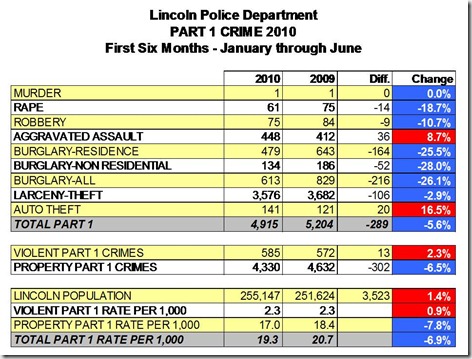
As you can see, only two of the Part 1 crimes are up—auto theft and aggravated assault. The decline in burglary is particularly large. Although there is a slight increase (13 offenses) in the violent crime category, it is overwhelmed by the significant decrease (-302 offenses) in the property crimes, so overall crime is down 5.6%. Considering the growth in the population during the past year or around 3,500 people, the crime rate is down 6.9% so far.
It’s always best to consider crime trends in light of the longer term, though, so you might want to look at the graphs contained in this post from earlier this year when the 2009 crime statistics were released. Slide number 11 in the embedded presentation would be the most meaningful.
Apart from the overall decline in crime, we are also having a banner year for crime clearance. Half way through 2010, the clearance rate stands at 32.5%, which is incredible. Good work all around!

As you can see, only two of the Part 1 crimes are up—auto theft and aggravated assault. The decline in burglary is particularly large. Although there is a slight increase (13 offenses) in the violent crime category, it is overwhelmed by the significant decrease (-302 offenses) in the property crimes, so overall crime is down 5.6%. Considering the growth in the population during the past year or around 3,500 people, the crime rate is down 6.9% so far.
It’s always best to consider crime trends in light of the longer term, though, so you might want to look at the graphs contained in this post from earlier this year when the 2009 crime statistics were released. Slide number 11 in the embedded presentation would be the most meaningful.
Apart from the overall decline in crime, we are also having a banner year for crime clearance. Half way through 2010, the clearance rate stands at 32.5%, which is incredible. Good work all around!
Monday, July 12, 2010
Better times ahead
Mayor Beutler’s proposed budget was released to the public yesterday, and will receive wide media coverage today. Bits and pieces of it have been coming out during the past week, but the whole enchilada is out there now. There are some significant cuts, and for the first time this includes substantial cuts to the police department. We will be losing 10 employees—our entire paraprofessional staff of public service officers, and one senior office assistant who provides technical support to our training staff.
Although the news media hasn’t seemed to grasp this, the PSOs do much more than downtown parking meter enforcement: they handle thousands of complaints from the public about parking problems all over the city, they deal with abandoned vehicle complaints, wheel tax evaders, traffic direction and control, found property, abandoned bicycles, assistance at traffic crashes, and a myriad of other duties that don’t require the authority of a sworn police officer. Of the nine PSOs, only four (actually, one is half-time, so it’s 3.5 of 8.5) deal with downtown parking enforcement.
Making these cuts isn’t easy. These are 10 dedicated City employees who average 23.1 years of service and work hard every day. I had to look them in the eye and tell them that they are not included in the budget, and it is through absolutely no fault of their own. In addition, we will be expected to find $375,000 in savings by watching the line items closely and by throttling our hiring of replacement staff carefully. As painful as this has been, I also realize that other City departments have dealt with these kinds of cuts for the past several years, when the police were for the most part immune from reductions.
Like most municipal governments in the United States, we have some significant financial challenges. As painful as this is, we are better off than most. Since we are dependent on over $600,000 in Federal revenue that is contingent on maintaining our sworn police officer strength at 321, the need for budget cuts at the police department required finding those cuts among our civilian staff.
In some respects, cutting civilian support staff is not good management. I have spent my professional life in management trying to civilianize jobs that did not require the services or more expensive police officers, and now we seem to be going backwards in this regard. I don’t know any other way to do it, though, when faced with a budget cut, than to prioritize the work, and drop those services that have the least connection to our core mission: “…to provide quality police services that promote a safe and secure community.”
I am something of a student of history, and this I know from that hobby: nothing stays the same, history repeats itself, everything is cyclical, and there will be better times ahead. In the meantime, we must be committed to delivering the best services we can with the resources that we are provided with by the citizens of Lincoln.
Although the news media hasn’t seemed to grasp this, the PSOs do much more than downtown parking meter enforcement: they handle thousands of complaints from the public about parking problems all over the city, they deal with abandoned vehicle complaints, wheel tax evaders, traffic direction and control, found property, abandoned bicycles, assistance at traffic crashes, and a myriad of other duties that don’t require the authority of a sworn police officer. Of the nine PSOs, only four (actually, one is half-time, so it’s 3.5 of 8.5) deal with downtown parking enforcement.
Making these cuts isn’t easy. These are 10 dedicated City employees who average 23.1 years of service and work hard every day. I had to look them in the eye and tell them that they are not included in the budget, and it is through absolutely no fault of their own. In addition, we will be expected to find $375,000 in savings by watching the line items closely and by throttling our hiring of replacement staff carefully. As painful as this has been, I also realize that other City departments have dealt with these kinds of cuts for the past several years, when the police were for the most part immune from reductions.
Like most municipal governments in the United States, we have some significant financial challenges. As painful as this is, we are better off than most. Since we are dependent on over $600,000 in Federal revenue that is contingent on maintaining our sworn police officer strength at 321, the need for budget cuts at the police department required finding those cuts among our civilian staff.
In some respects, cutting civilian support staff is not good management. I have spent my professional life in management trying to civilianize jobs that did not require the services or more expensive police officers, and now we seem to be going backwards in this regard. I don’t know any other way to do it, though, when faced with a budget cut, than to prioritize the work, and drop those services that have the least connection to our core mission: “…to provide quality police services that promote a safe and secure community.”
I am something of a student of history, and this I know from that hobby: nothing stays the same, history repeats itself, everything is cyclical, and there will be better times ahead. In the meantime, we must be committed to delivering the best services we can with the resources that we are provided with by the citizens of Lincoln.
Friday, July 9, 2010
New hate crime law
Tuesday, I was among eight LPD officers who attended a day-long training session on hate crimes sponsored by the United States Attorney for the District of Nebraska, Deborah Gilg. It was a good session, and included an interesting multicultural panel in the afternoon, as well as a thoughtful morning presentation by the retired chief of the Laramie, WY police department, Dave O’Malley. Mr. O’Malley described the impact of the murder of Matt Shepard.
The most practical portion of the training was presented by several lawyers from the Department of Justice, who briefed us on the changes to the Federal law concerning hate crimes as a result of the Matthew Shepard and James Byrd Jr. Act, passed in Congress last fall.
I was seated next to Capt. Marty Fehringer. He and I were recalling Lincoln’s own gay-bashing homicide that would have been a prime candidate for Federal prosecution under this law had it existed in 1993, when Lincoln shoe salesman Harold Grover was murdered by Clifford Privat and Troy Leger. I was marginally involved in the investigation as Lancaster County Sheriff; Marty was personally acquainted with the victim.
The murder of Mr. Grover, in my mind quite a sensational crime and not really that long ago, seems to be lost in the mist: I Googled the case and came up empty-handed. It is certainly the most dastardly hate crime in our City and County during my years of service.
The most practical portion of the training was presented by several lawyers from the Department of Justice, who briefed us on the changes to the Federal law concerning hate crimes as a result of the Matthew Shepard and James Byrd Jr. Act, passed in Congress last fall.
I was seated next to Capt. Marty Fehringer. He and I were recalling Lincoln’s own gay-bashing homicide that would have been a prime candidate for Federal prosecution under this law had it existed in 1993, when Lincoln shoe salesman Harold Grover was murdered by Clifford Privat and Troy Leger. I was marginally involved in the investigation as Lancaster County Sheriff; Marty was personally acquainted with the victim.
The murder of Mr. Grover, in my mind quite a sensational crime and not really that long ago, seems to be lost in the mist: I Googled the case and came up empty-handed. It is certainly the most dastardly hate crime in our City and County during my years of service.
Tuesday, July 6, 2010
Six Fourths
Independence Day is normally one of the busiest days of the year for the Lincoln Police Department. This depends, however, on the day of the week it falls upon, and (of course) the weather. This year’s rain obviously played a role in keeping a lid on the police dispatches, which look like this over the past six years:
2010 383
2009 428
2008 439
2007 441
2006 448
2005 462
2010 383
2009 428
2008 439
2007 441
2006 448
2005 462
Friday, July 2, 2010
Lock or not
An interesting comment at 12:12 on my Wednesday post dealt with the efficacy of locking your car as a deterrent to the crime of larceny from auto:
Let’s see if I can live up to that vote of confidence. I’m not so certain. A seasoned fellow employee whose opinion I trust a great deal made the argument to me a few weeks ago that in some cases, it’s better to leave your car unlocked. His rationale was this: his daughter’s car had been broken into, even when there was nothing of value inside. The risk of loss from a stolen stereo, purse, iPod, sunglasses, etc. was effectively nil, but the cost of replacing the broken window was considerable. She would have been better off, he reasoned, if the thieves would have just opened the door, rummaged around, and figured that there was nothing worth taking.
There is, however, the car itself. I hate to disagree, but to my way of thinking, anything you do that causes the criminal to expend more energy, take more time, make more noise, and generally expose himself to more risk is a good strategy in the long run. To illustrate, I looked at all larcenies from auto so far this year. There have been 1,078 through the end of June. Of those, 454 (42%) of the vehicles were unlocked. Entry was gained by breaking a window in 210 cases (19%). In the remainder, either the lock was slipped or the method of entry was unknown. I do not doubt that many of those cases actually involved an unlocked door, but the victim wasn’t aware (or didn’t want to admit) that the vehicle was unlocked.
This evidence would suggest that locking up is the best policy—despite the slight risk of a glass break. One of the final comments from Wednesday’s topic (10:07 July 1) summed up my viewpoint quite well:
“I don't think it matters anymore whether the items are in view or hidden, or whether the car is locked or not. These car break-ins are happening almost daily in the parking lots…”A few minutes later, another comment at 1:32 said,
“I'm pretty sure that the Chief can destroy that argument, with one hand tied behind his back.”
Let’s see if I can live up to that vote of confidence. I’m not so certain. A seasoned fellow employee whose opinion I trust a great deal made the argument to me a few weeks ago that in some cases, it’s better to leave your car unlocked. His rationale was this: his daughter’s car had been broken into, even when there was nothing of value inside. The risk of loss from a stolen stereo, purse, iPod, sunglasses, etc. was effectively nil, but the cost of replacing the broken window was considerable. She would have been better off, he reasoned, if the thieves would have just opened the door, rummaged around, and figured that there was nothing worth taking.
There is, however, the car itself. I hate to disagree, but to my way of thinking, anything you do that causes the criminal to expend more energy, take more time, make more noise, and generally expose himself to more risk is a good strategy in the long run. To illustrate, I looked at all larcenies from auto so far this year. There have been 1,078 through the end of June. Of those, 454 (42%) of the vehicles were unlocked. Entry was gained by breaking a window in 210 cases (19%). In the remainder, either the lock was slipped or the method of entry was unknown. I do not doubt that many of those cases actually involved an unlocked door, but the victim wasn’t aware (or didn’t want to admit) that the vehicle was unlocked.
This evidence would suggest that locking up is the best policy—despite the slight risk of a glass break. One of the final comments from Wednesday’s topic (10:07 July 1) summed up my viewpoint quite well:
“Most appealing LFA:
1. Visible loot, unlocked door
2. No visible loot, unlocked door (toss car for any loot, maybe even the keys will be in the glove compartment)
3. Visible loot, locked door
4. No visible loot, locked door
As you go down the list, the risk vs reward gets less and less appealing. If given a choice of something higher on the list vs something lower on the list, the crook will almost always choose the higher option. There is always some dummy who at least does #3, if not #2, or even #1. Make sure that you're only offering option #4”
Subscribe to:
Posts (Atom)
